
Choose a build by the engine you can assemble now: Demon Altar with expendable troops, a supported melee carry, an early Mycelium, or a Dispenser backed by income. Give that engine time to grow, then add the protection or damage type it lacks. A complete build needs a way to survive its opening as well as a way to scale.
These recommendations use version 0.9.8, Patch #31. They are conditional build paths, rather than a claim that one setup wins every difficulty. The deck rework changed several old combinations: Reinforce now provides health growth during combat, Oblation replaced Vampirism, and Recycler replaced the old Progress Precision card. Start a new run after updating so its stored data uses the current rules.
Choose the engine before choosing every card
The useful question is what makes your army stronger between the current battle and the next difficult fight. More cards do not automatically answer that question. A second damage unit can dilute support that would have made your first unit reliable; another support building can also be a mistake when no troop benefits from it.
| Build path | Working core | First problem to solve | Reason to change direction |
|---|---|---|---|
| Death and summons | Demon Altar, Imp, Cemetery | Keep enemies occupied while summons develop | Deaths are scarce or the Demon dies before contributing |
| Supported melee | Paladin or Soldier, Farm, Blacksmith | Concentrate upgrades and sustain the frontline | Enemy ranged or area damage bypasses the frontline |
| Nature scaling | Mycelium, Forest, Boar, a suitable rider | Survive while spores and health accumulate | A late support draw cannot repair immediate damage |
| Gold scaling | Dispenser, Vault, Mercenary | Earn gold without removing the army | Spending reduces troop count below a safe level |
| Tower pressure | Trebuchet or Scout Tower, Quarry or Blacksmith | Buy enough firing time | Enemies reach the towers before repeated attacks |
This table gives you a starting commitment. It does not require a fixed deck of nine exact cards. Your king provides a foundation, while enemies introduce additional cards that can improve it. A good build remains recognizable after substitutions because the replacement fills the same job.
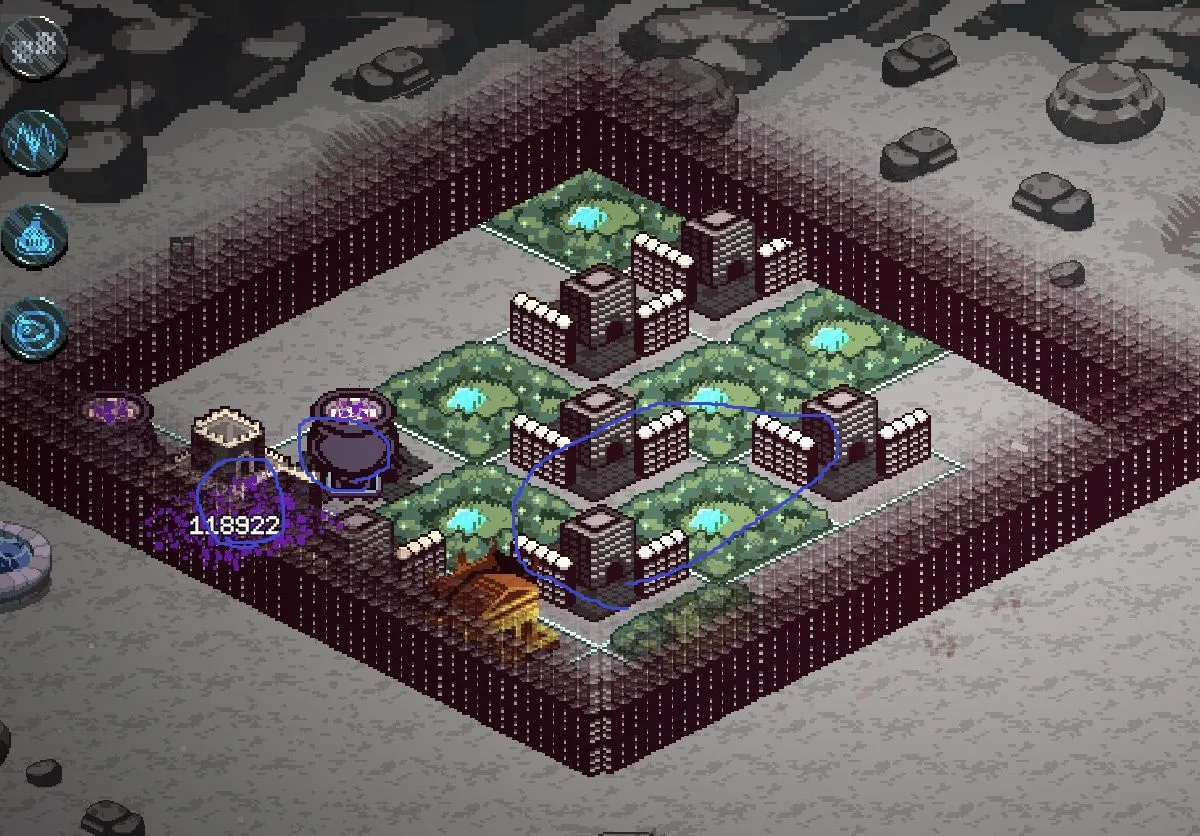
Layout reference only; use current card previews for stats and effects.
Establish a frontline and a damage source
Begin by identifying what survives contact and what finishes enemies. Sometimes the same plot can do both. A supported Paladin, for example, can be your frontline while other cards improve its offensive contribution. In a Blood build, Imps occupy the enemy while Demon Altar supplies a longer term damage plan.
Do not judge a plot only by whether it delivers the final hit. A troop that buys time for a tower has a meaningful role. Conversely, an expensive tower that never gets a useful shot has not become good simply because its displayed damage is large.
Use your first battles to establish which failure actually occurs. If your army survives but the enemy frontline remains intact, improve damage or add an appropriate effect. If your best attacker disappears immediately, spend on protection or screening. If both fail, prioritize a compact core over another distant scaling project.
An opening does not need every eventual support piece. It needs enough direct power to make the next reward accessible. Take a useful duplicate or a viable troop before placing a building whose payoff depends on several cards you have not drawn.
Build a Blood engine around controlled losses
Demon Altar benefits from allied deaths. Imp squads and Cemetery provide a natural structure for keeping enemies engaged while producing those deaths. Place an Altar early enough to participate in the run's growth, then make sure you still have troops to hold enemy attention.
Current Blood cards require care when reading older advice. Pagoda summons Ghosts and its count grows through unit destruction. Cemetery summons Skeletons, including a passive interaction when an adjacent troop plot is destroyed. Mangler now summons meat trolls; Patch #31 also gives it health when it destroys units. These are active decisions about fodder and board space, rather than a reason to copy an old tower diagram unchanged.
Oblation creates another route to unit growth through the pit. Recycler, borrowed from Progress, can reward pit use with damage and health for adjacent plots. Consider that pair when you already have a troop core and can place the support where its recipients actually benefit.
Avoid building both a full Altar engine and a separate Mangler feeding system before either works. The two plans compete for units and plots. Add Mangler when its consumption leaves enough screening for the Demons, or use it as an alternative damage source when the Altar route is not developing.
Support one strong melee plot
A Paladin or Soldier build is easier to manage when you choose one principal troop plot and direct your important upgrades toward it. Farm contributes troop growth, Blacksmith improves attack, and Steel Coat protects against an incoming hit. Off-faction Forest or Beacon can fill a health or speed need when available.
Place support beside the intended recipient. Most adjacency effects use the four cardinal directions. A diagonal plot does not become connected just because the objects look close together. Before occupying an empty tile, check whether that placement removes the only remaining place for a support building touching your carry.
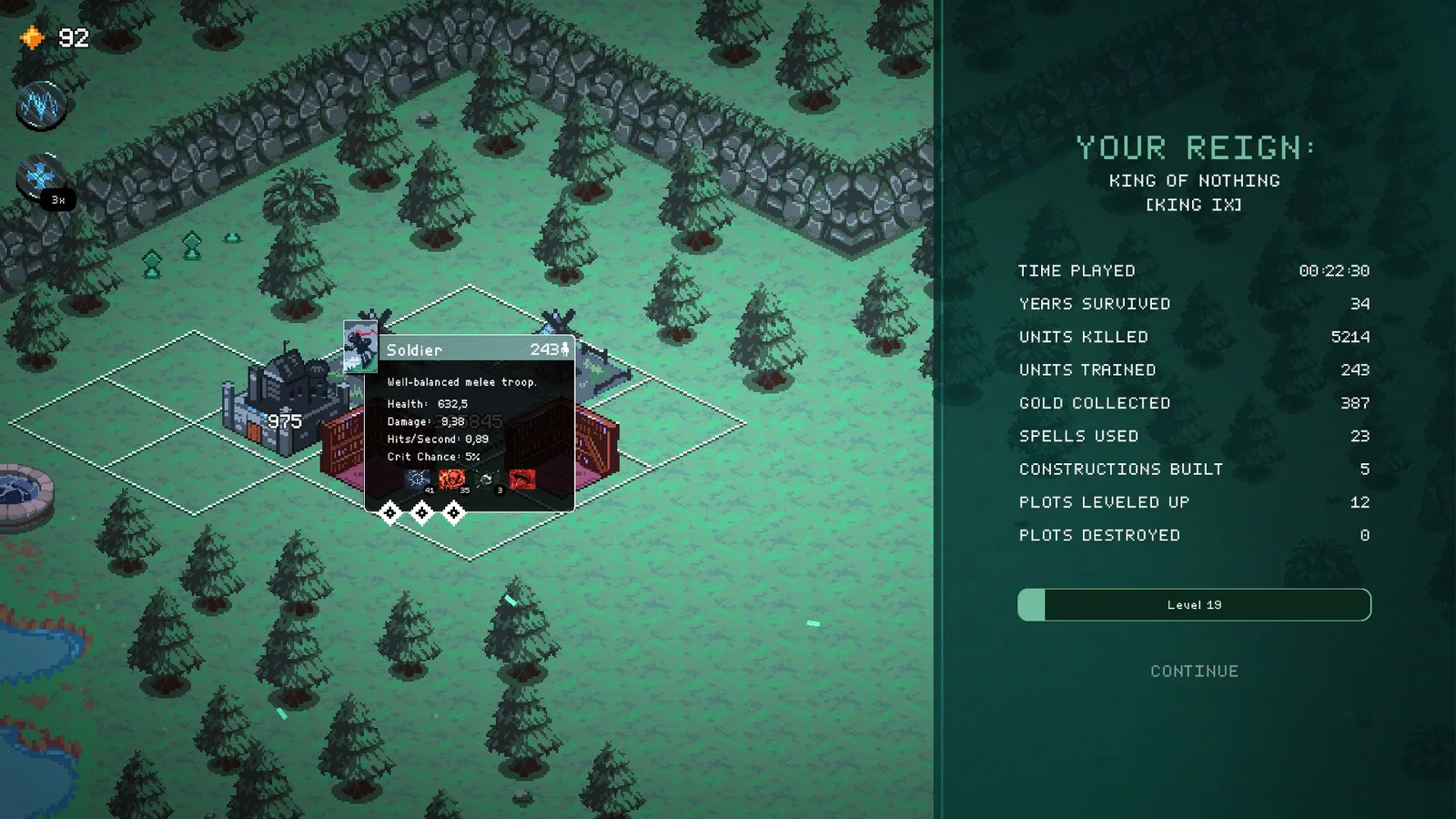
Layout reference only; use current card previews for stats and effects.
A central support plot can serve several neighboring recipients, but maximum coverage is not always the goal. A Farm aimed at your principal frontline may be more useful than a Farm sharing its output with a troop you intend to replace. Choose recipients deliberately.
The replacement for an unavailable support card depends on the problem. More troops can help maintain a frontline; health support improves durability; a damage support helps finish targets. These are related jobs, but they are not interchangeable. Do not treat a Farm as a guaranteed substitute for damage when your army already survives comfortably.
Use Nature's time and health engines
Mycelium is an investment in accumulated spores. An early placement has more opportunity to develop than the same card appearing after your army has already fallen behind. Protect the build's opening rather than assuming a new Mycelium will immediately rescue it.
Forest grows neighboring troop health. Boar turns its own health into value for a rider, so the quality of a Boar combination depends on the support the Boar receives. Match the rider to a specific offensive job instead of attaching whichever unit happened to appear.
A ranged rider, an area damage rider, and a defensive rider solve different encounters. The pairing also changes which plot must receive upgrades. Watch whether the combined troop is surviving and contributing, then reinforce the weak part of that relationship.
Patch #31 slightly buffed Elf and Mycelium, but that does not establish that every Nature opening is stronger than every alternative. On demanding difficulties, immediate combat power remains necessary. Keep a separate plan for enemies that reach or target the backline before your slow growth pays off.
Convert gold into combat without emptying the army
Dispenser improves through gold received. Vault provides an income route and now automatically levels each year. Mercenary uses gold you hold to determine its unit count; after the deck rework the baseline is nine gold per unit. Those mechanisms create a real spending tradeoff.
Earning and holding gold are different jobs. Income can strengthen a Dispenser even when you later spend money, while spending can reduce the army supported by Mercenary. Check the troop count before and after a purchase rather than assuming that a full wallet is always wasteful or always beneficial.
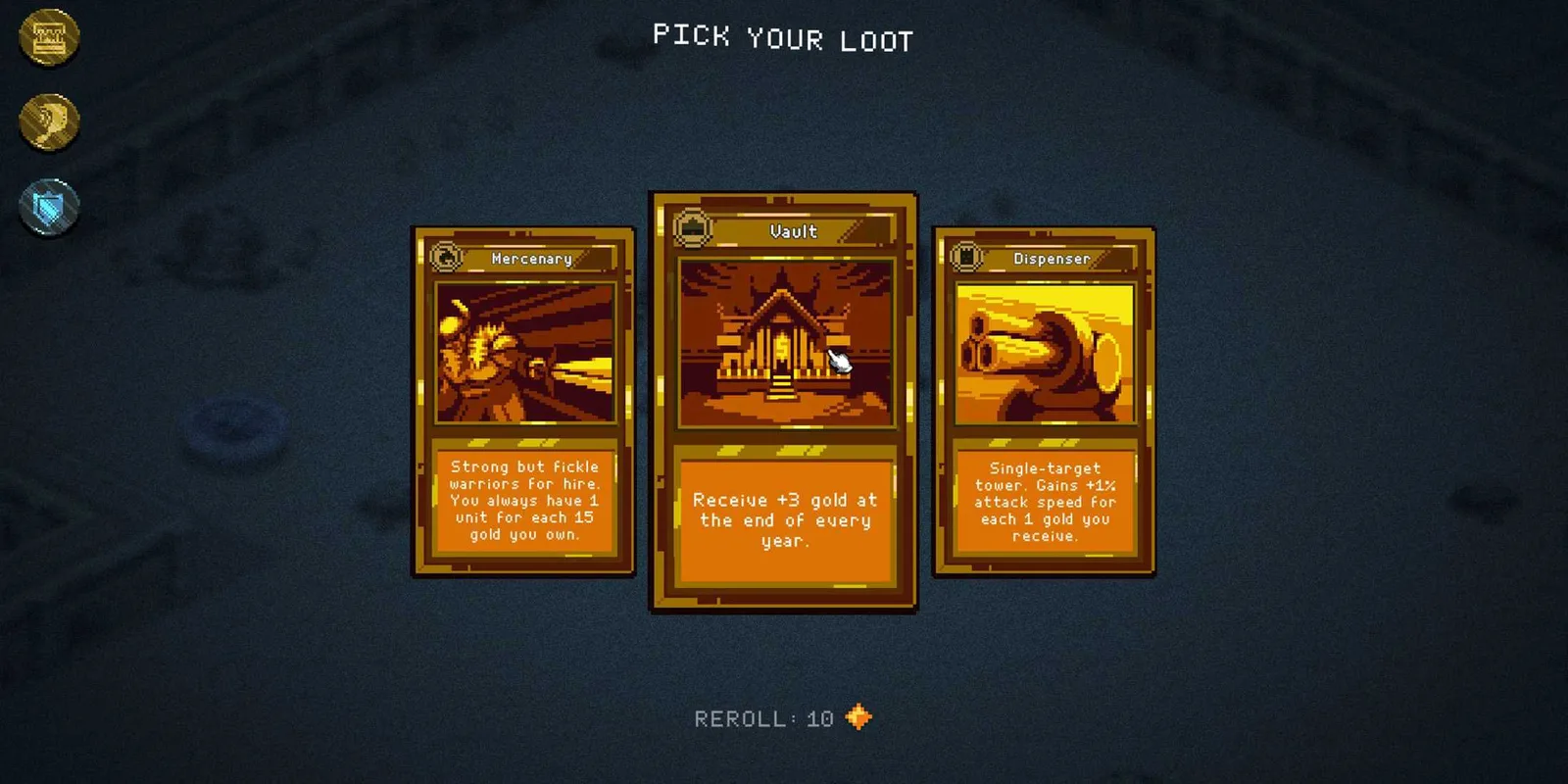
The pictured Mercenary cost is historical; its current baseline is nine gold per unit.
A Beacon improves nearby attack and movement speed. Blacksmith or Quarry can address tower damage. Mortgage can convert an expendable plot into gold, but the plot is destroyed: a profitable demolition is still a bad trade if it removes the only screen protecting your Dispenser.
Do not pursue an old gold exploit as the engine. Patch #30 fixed unintended loot duplication, extra gold from buying with a full hand, and excessive Vault leveling through Overhaul and Speculation. Build around the visible current card effects and an army that survives ordinary fights.
Give towers enough time to work
A tower build must be evaluated as damage delivered during the battle, rather than damage displayed on a card. Scout Tower gains projectiles with levels. Trebuchet's projectiles deal area damage after the deck rework. Quarry provides tower damage growth, while Blacksmith can support nearby recipients.
Wallmaker or a troop frontline can delay contact with your damage source. Trapper traps now stun, with improved damage in Patch #31, making them worth considering when your problem is lack of firing time. None of these options removes the need to observe how enemies approach.
A slow but powerful attack can struggle against a large spread of small targets. A quicker tower can still fail if each hit contributes too little against durable enemies. Add a complementary attacker when the first tower has a targeting or damage pattern that leaves a clear gap.
Adapt rewards without abandoning the core
For each reward, choose among immediate stabilization, engine growth, and preparation for a known problem. These priorities change as the run develops. A duplicate that keeps you alive now can be better than a rare support card whose useful recipient does not exist.
Use rerolls with a defined acceptable outcome. For an Altar build, that might be a screen, a Cemetery connection, or an Altar improvement. For gold scaling, it might be a damage upgrade or income that your present defense can afford. Stop searching when you have a satisfactory solution rather than spending everything on one exact card.
Diplomacy affects both enemy pressure and the reward pool. Keep access to a king's cards when you still need a meaningful tool from that deck, but reassess once the tool is acquired and its army becomes dangerous. A theoretical perfect reward is not valuable if you cannot survive the next encounter.
Repair the failure that appears in battle
When a build loses, identify the first decisive failure. A missing frontline calls for screening or durability. A protected army that cannot finish the enemy needs damage, attack opportunities, or an effect suited to its targets. A dead carry needs protection before another multiplier.
Avoid solving every loss with a new scaling building. Growth is useful only while the run remains alive to receive it. At the same time, do not strip out the only source of future growth merely to add a small temporary improvement. Keep the engine, repair its weakest link, and let subsequent rewards determine how far that particular setup can go.