
9 Kings is a strong fit if you enjoy short decision loops, compact kingdom layouts and combinations that grow far beyond their starting strength. Its main appeal is preparing an army and support engine, then watching automatic battles reveal whether that plan works. It is a less direct fit if you want continuous unit control, a large narrative campaign, or complete freedom to build a chosen combination without random rewards.
This is an assessment of the game's documented design and current feature set, not a report of personal playtime or hardware testing. As of October 12, 2026, the PC game is in Early Access on version 0.9.8, Patch #31. Its announced 1.0 release is November 12, 2026. Features announced for that release, including Joker custom mode, remain future features here.
A small kingdom creates the decisions
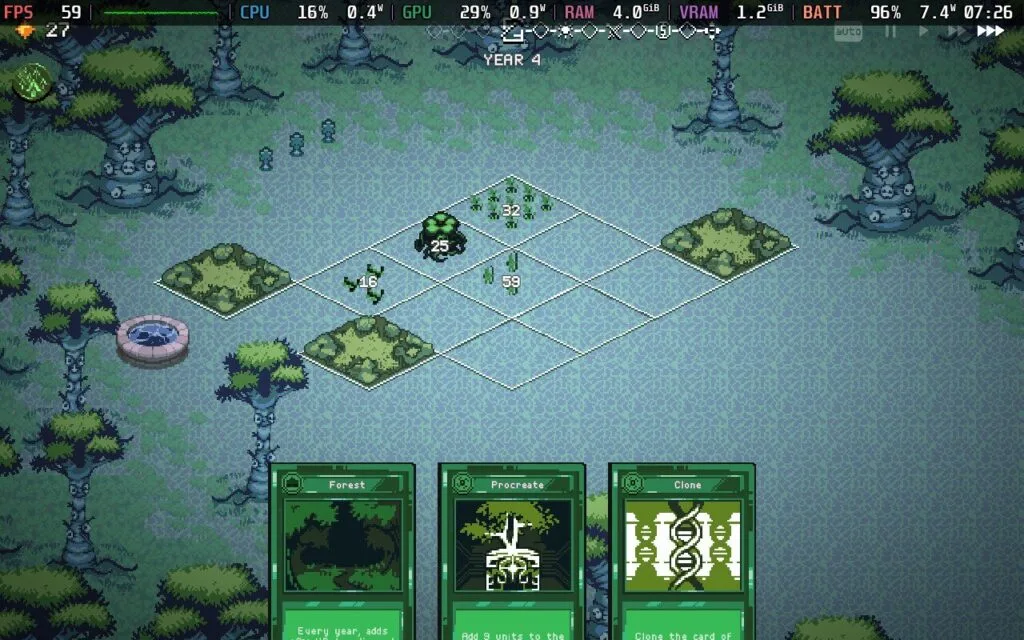
A small kingdom leaves room to plan support around the available troop plots.
The starting kingdom is compact. Cards create or improve plots containing troops, constructions and support effects. That makes space a meaningful resource from the opening: placing one more attacker can obstruct the support arrangement that would make existing attackers stronger.
This is the design's clearest strength. You are not simply enlarging an army until its total number exceeds the enemy. You are deciding which plot deserves investment and which neighboring space helps it perform. The value of a card depends on that relationship. A useful support building beside the wrong recipient can contribute less than a modest upgrade to a plot that already carries the battle.
Duplicate cards improve an existing plot, while tools such as Wildcard provide another route to upgrades. The kingdom therefore changes through development as well as expansion. This keeps the board readable enough to examine between fights, even when the battle itself becomes crowded.
The limitation is that a compact kingdom can encourage concentration. Once you recognize a powerful recipient, many decisions become about feeding that same plot. Whether that feels satisfying or repetitive depends on how much you enjoy optimization within a small arrangement. Players wanting a broad city with several independent systems should expect a more focused kind of building game.
Combat tests preparation more than reflexes
Battles are automatic, with the ruler's base offering an ability that can be controlled. Most of your strategic work happens before combat: deciding what to place, where to place it, what to upgrade and which supporting effects are worth the available space.
That distinction is useful for deciding whether the game suits you. If you like planning an encounter and then inspecting the result, the automatic battle is part of the appeal. If you want to direct squads, manage formations continuously or rescue a unit with precise movement orders, the design does not promise that kind of control.
Automatic combat still produces information. You can see whether the front collapses too early, whether a ranged force gets enough time to attack, or whether your damage is concentrated on the wrong kind of target. Those observations give the next card choice a purpose. The enjoyment comes from connecting a visible failure with a better preparation decision.
The battlefield's tiny pixel units can also reduce clarity when armies become large. A reader should distinguish visual simplicity from effortless readability. The board may be concise while the combat remains busy. Current Compendium stats and improved tooltips help examine the underlying cards, but they do not make every crowded battle easy to parse at a glance.
Rival cards create the replay value
A ruler begins with its own deck identity, but rewards can supply rival kings' cards. Diplomacy lets you favor opponents whose tools support your plan and move away from opponents whose cards are less useful. That gives the game a reason to revisit the same starting ruler without repeating exactly the same kingdom.
The most interesting consequence is that theme does not lock you into one toolkit. A conventional army can use a different faction's support, and a tower kingdom can borrow protection or an upgrade tool. Your plan becomes a response to the cards you encounter instead of a fixed list completed in the same order every time.
That flexibility is also where randomness matters. A coherent late-game concept can remain incomplete if the needed support never appears early enough. Shops and rerolls give you some agency, but spending resources for an ideal reward is still a choice with a cost. The game asks you to adapt; it does not guarantee that every run will support the experiment you intended.
For players who enjoy discovering an alternative use for a surprising card, this is replay value. For players who mainly want to test a predetermined combination, it can feel like friction. The same reward system creates both reactions. Buy on the assumption that the present game asks for adaptation, not on the promise that a planned custom mode will remove the constraint later.
The rulers change the starting problem
Nine playable kings cover different starting identities. Nothing offers a broad conventional toolkit, Stone emphasizes defenses, Greed connects gold to combat, Blood turns losses and destruction into value, and Progress rewards upgrades and recycling. Nature, Spells, Nomads and Time add their own forms of development and interaction.
The useful distinction is not simply cosmetic. A Greed player must think about the fighting force after spending gold. A Blood player must account for the unit lost to a sacrifice. A Progress player must understand what an upgrade action triggers. These are different decision problems even when all the kingdoms ultimately need enough damage and survival.
King-specific perks and decrees deepen those identities. At the same time, the ability to borrow cards means an unlocked king is not the only route to seeing its tools. You can encounter an interesting mechanic in another run and later choose the corresponding ruler to explore it more deliberately.
This supports replaying for mastery, but progression also affects comparisons. A developed ruler with a familiar loadout is easier to evaluate than a freshly unlocked one. Switching after one disappointing opening does not establish that the new king is weak. The game rewards learning how a deck's pieces work together before judging its longer-term possibilities.
Current modes provide different objectives
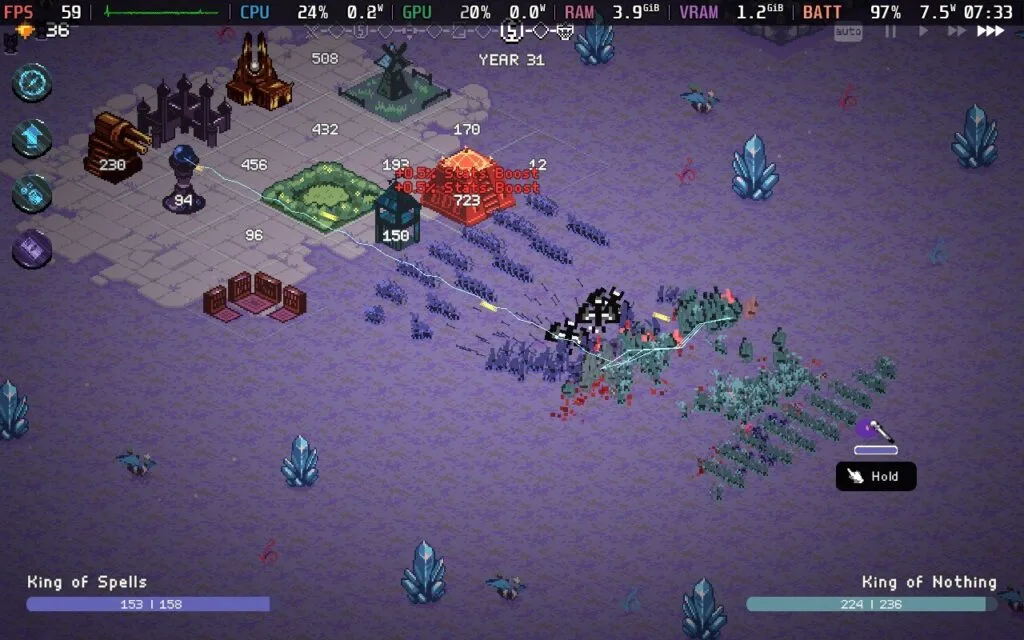
Battles show whether the prepared army and support can stop the opposing force.
Singleplayer supplies the central survival loop. The intended ordinary experience is the 33-year run. Completing that objective gives a defined target, which is useful if you prefer attempts with an identifiable ending rather than an open city that can expand indefinitely.
Endless play continues beyond the standard campaign. Current messaging identifies year 99 as the game's true ending, while allowing continued play afterward. The developer has clarified that there is no further experience gain beyond year 99. That makes extended survival an optional experiment rather than an unlimited progression requirement.
Quest mode is already available and presents challenges with altered mechanics. It can provide a more focused task than simply asking how far a general-purpose kingdom survives. If you enjoy a game giving an engine or constraint a specific setting, this is an additional reason to consider the current package.
Asynchronous multiplayer is also available. It compares your kingdom's survival against rival kings without requiring everyone to be continuously present in the same live match. Patch #31 added post-game kingdom review and ranking gameplay stats, giving players more information about successful boards after the attempt.
The multiplayer decree pool rotates by season. That is a material difference from importing a single permanent recipe into every competitive run. It can encourage adaptation, but also means a guide's assumed decree may be absent. Competitive value should be judged against the current season rather than old screenshots of a successful combination.
Balance changes affect old impressions
The game has changed meaningfully since its early reviews. The large deck rework introduced Oblation and Recycler, changed Reinforce into a health effect during battle, adjusted several summons, and changed Vault progression. Patch #30 then reworked perks and removed exploits. Patch #31 continued with damage buffs, interface improvements and critical bug fixes.
These changes matter more than treating every old numerical judgment as current. A guide dismissing Vault because it only occupies a plot for limited income may be evaluating an earlier version. A build using Reinforce for upgrade-triggered damage is no longer describing its present effect. The card illustrations may remain recognizable while the strategy underneath them has changed.
This is encouraging if you like a design receiving substantial iteration. It is also a cost if you want a stable rulebook to learn once. The game can reward rereading descriptions after an update, and a stored old run does not automatically acquire the newest run data. Fresh runs are required to apply patch changes.
No current balance note proves that a particular strategy wins a stated percentage of games. The sensible expectation is a developing system with several viable identities, not a solved competitive ranking. If certainty about an enduring strongest deck is central to your enjoyment, Early Access is a less comfortable setting.
Presentation favors the strategic view
The visual style is minimalist pixel art. Cards and structures carry recognizable identities, while units become small figures across a large battlefield. This supports the game's compact planning loop and the spectacle of many units fighting, but it does not aim for close-up character animation or detailed battlefield storytelling.
The soundtrack and ruler-themed environments provide atmosphere around repeated attempts. Their practical role is to support a loop you will revisit, rather than carry a dramatic narrative. Players seeking a story with extensive dialogue and authored characters should treat the kingdom-building systems as the primary product.
Accessibility and controls deserve a current-version check rather than an old review's assumptions. The present Steam listing shows full controller support and Steam Deck verification, whereas early coverage described a mouse-oriented control setup without native controller support. Patch notes also document controller and Steam Deck interface improvements. The older limitation should not be repeated as the current state.
That verification is not a benchmark for every late-game kingdom. This assessment does not promise a frame rate, battery duration or readable text size on your hardware. Extremely large troop counts are a different load from an ordinary campaign, and patches improving performance do not establish unlimited scaling without technical limits.
The main reasons to hesitate
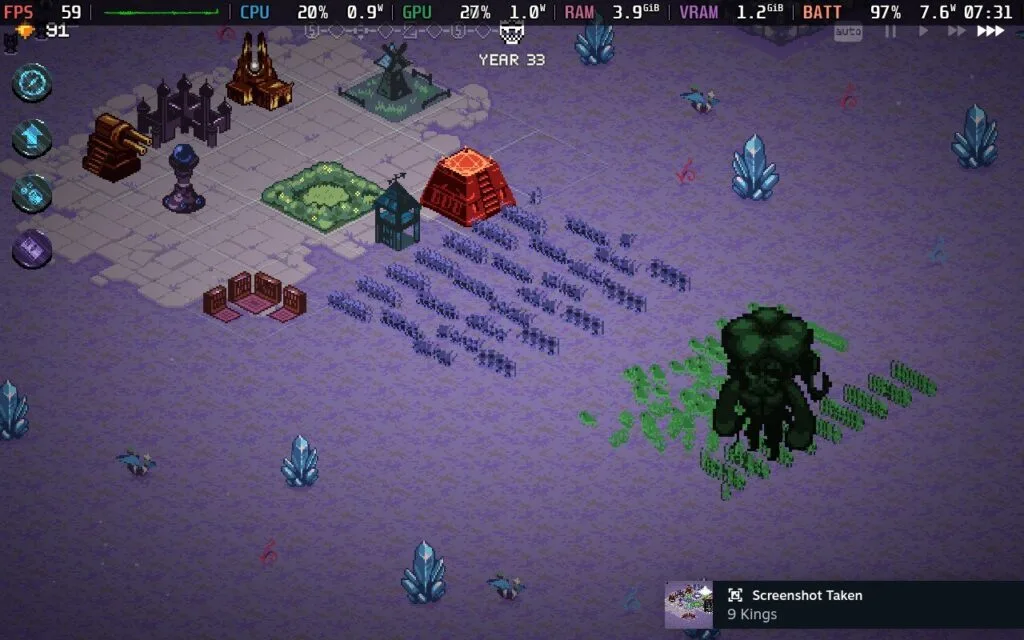
The ordinary campaign culminates in the year 33 battle.
Random rewards are the clearest reservation. If you dislike restarting or adapting when a planned engine fails to arrive, the same systems that create surprise can undermine the experience you wanted. Higher-difficulty play can expose that tension because an inefficient opening has less room to recover.
A second reservation is that elaborate growth can concentrate attention on a small set of recipients. You may find the optimization satisfying, or you may prefer a game where several independent armies or cities remain equally important. The compact grid creates meaningful constraints, but those constraints also define the scope of the simulation.
A third is the developing version. The announced 1.0 date provides a near-term milestone, but it does not make future content available today. Evaluate the modes and tools already present. Waiting for launch is reasonable if you want to assess the complete release before learning mechanics that may change again.
Older crash and performance stories should be read as historical observations, not reproduced as confirmed defects in Patch #31. Conversely, recent fixes cannot guarantee that every extreme endless experiment is stable. The strongest supported position is that the game is actively improving and very large-scale play remains a separate expectation from ordinary runs.
Decide from the experience you want
Choose 9 Kings if you want to solve compact board problems, develop support relationships, mix rival cards and see a modest kingdom become unusually powerful. Its automatic battles work well with that preparation-focused goal, and the current singleplayer, Quest, Endless and asynchronous multiplayer modes give that loop several contexts.
Wait or pass if your priority is continuous unit command, a large narrative, or unrestricted testing of a chosen build from the first turn. Those preferences describe a different experience from the present game. The current recommendation rests on its documented decision structure and available content, with no invented playtime, personal score or performance guarantee.