
Build King of Greed around a combat core that uses your economy: Palace contributes base damage, a Dispenser gains speed from gold earned, and Mercenary troops turn held gold into a screen. Use Vault for income, Beacon for nearby speed, and an available damage support when the tower needs stronger hits. Prioritize the missing combat piece before adding another economy plot.
This plan uses version 0.9.8. Old Greed guides often describe a pre-rework Vault or use fifteen gold per Mercenary; the current baseline is nine, and Vault automatically levels each year. The recommendations are conditional on the cards you draw and do not establish a guaranteed King IX clear.
Choose the primary damage plan
Greed can concentrate on Palace with speed support, build around Dispenser, or use a substantial Mercenary army supported by other factions. These paths overlap, but the early investment should have a clear focus.
| Path | First investment | Necessary companion | Main risk |
|---|---|---|---|
| Palace support | Base levels and useful Beacon connections | A screen and a complementary damage route | Single-target output cannot solve every encounter |
| Dispenser economy | Early Dispenser plus gold receipts | Frontline and damage support | Speed develops while enemies remain too durable |
| Mercenary army | Maintain gold and improve the troop plot | Support that makes each troop useful | Spending shrinks the army at the wrong moment |
You do not need to decide the final path before seeing your opening. A hand with a Dispenser and a usable screen offers a different opportunity from a hand dominated by Mercenary and support cards. Commit to what can fight now and let later rewards expand it.
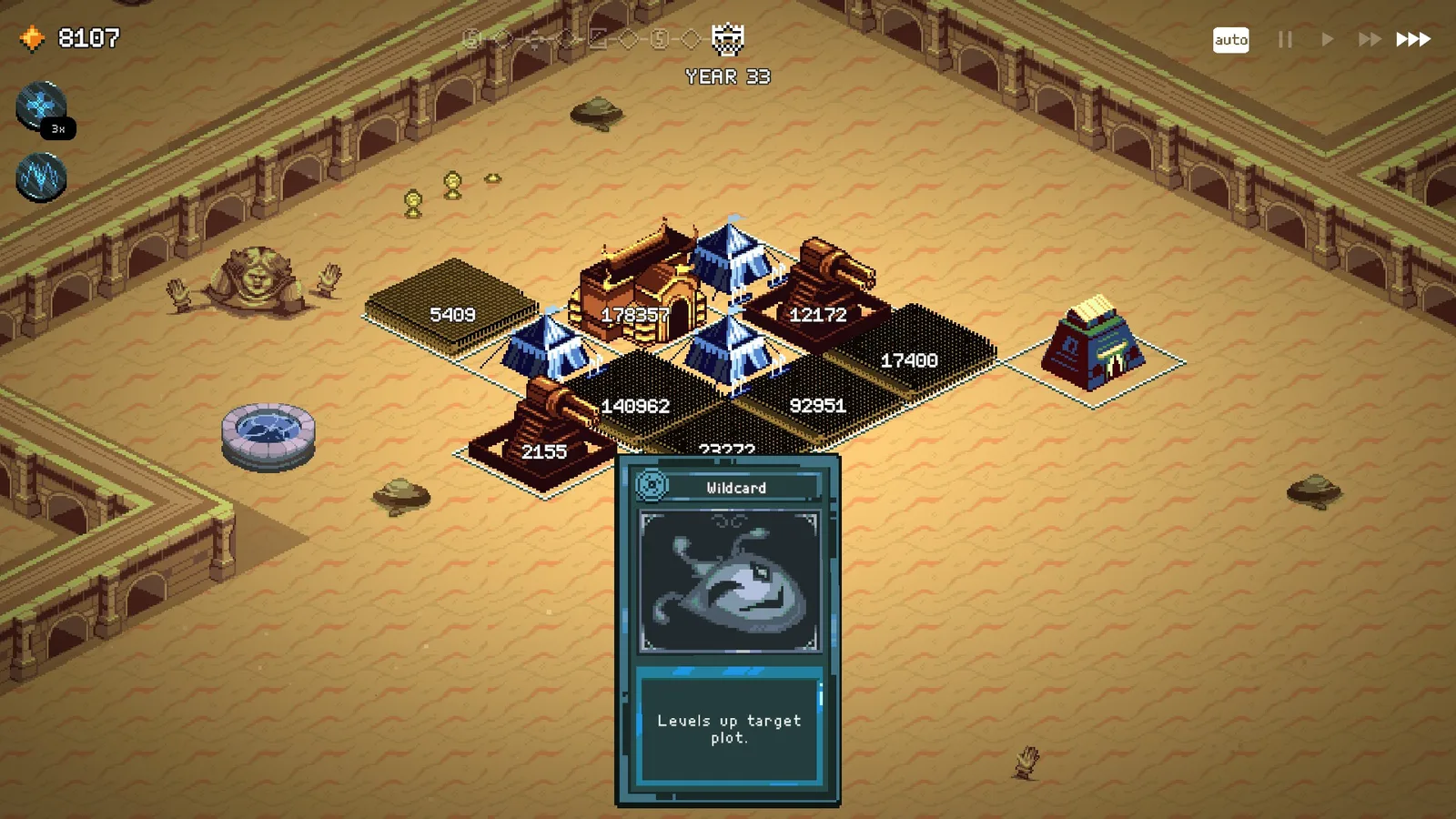
Layout reference only; use current card previews for stats and effects.
The key distinction is between growth and immediate power. A new Vault can improve future income, but a duplicate for the troop holding your frontline may be the only choice that keeps the present run alive. Make the economy serve the army rather than the reverse.
Position Palace for the support you expect
Place Palace where planned speed support can reach it without consuming every useful frontline tile. An edge or rear location can leave the center open, but the best choice depends on your unlocked plots and starting cards.
Beacon benefits adjacent recipients and now improves movement speed as well as attack speed. Check its connections to Palace, Dispenser, or important troops before placing another card beside it. A diagonal relationship is not the cardinal adjacency used by these effects.
A central Beacon can improve several recipients. A narrower connection can also be worthwhile if it strengthens the one plot responsible for most of your damage. Do not choose maximum coverage when it connects mostly to buildings that do not need the buff.
If your plan relies heavily on Palace, retain an answer to enemies the base does not finish efficiently. A tower or useful troop can provide that complementary damage. One impressive attack effect does not eliminate the need for a complete army.
Survive the opening with the troop you have
Mercenary is the natural frontline for a held-gold plan. Thief supplies a different job by reaching an enemy backline. A Thief opening can therefore be useful, but it should not be mistaken for the same kind of durable screen.
If your first troop is limited, support its actual role while seeking a more reliable frontline. Do not save every resource for Dispenser while your only troop disappears immediately. A temporary off-faction unit can be a sensible bridge toward the desired core.
Watch which enemies cause the first loss. If ranged units kill your valuable attackers before the frontlines meet, another fragile damage troop may leave the problem unchanged. If your screen lasts but the enemy remains healthy, invest in damage or an appropriate attack effect.
Older Greed plans sometimes advise intentionally losing lives for economy perks. That is not necessary for this build. A loss can leave you with fewer opportunities to repair the army, and old perk values may no longer describe the current loadout. Plan to survive; use the actual consequences of a loss if one happens.
Put Dispenser in early and feed its growth
An early Dispenser has more opportunities to benefit from future gold receipts. Once it is placed, Vault income and other ordinary gold sources contribute to its speed growth. A Dispenser drawn late should not be treated as though it has already collected those earlier benefits.
First make the tower useful, then expand. A duplicate or a relevant damage support can be more effective than a second underdeveloped Dispenser. Multiple towers with the same weakness still leave you with that weakness.
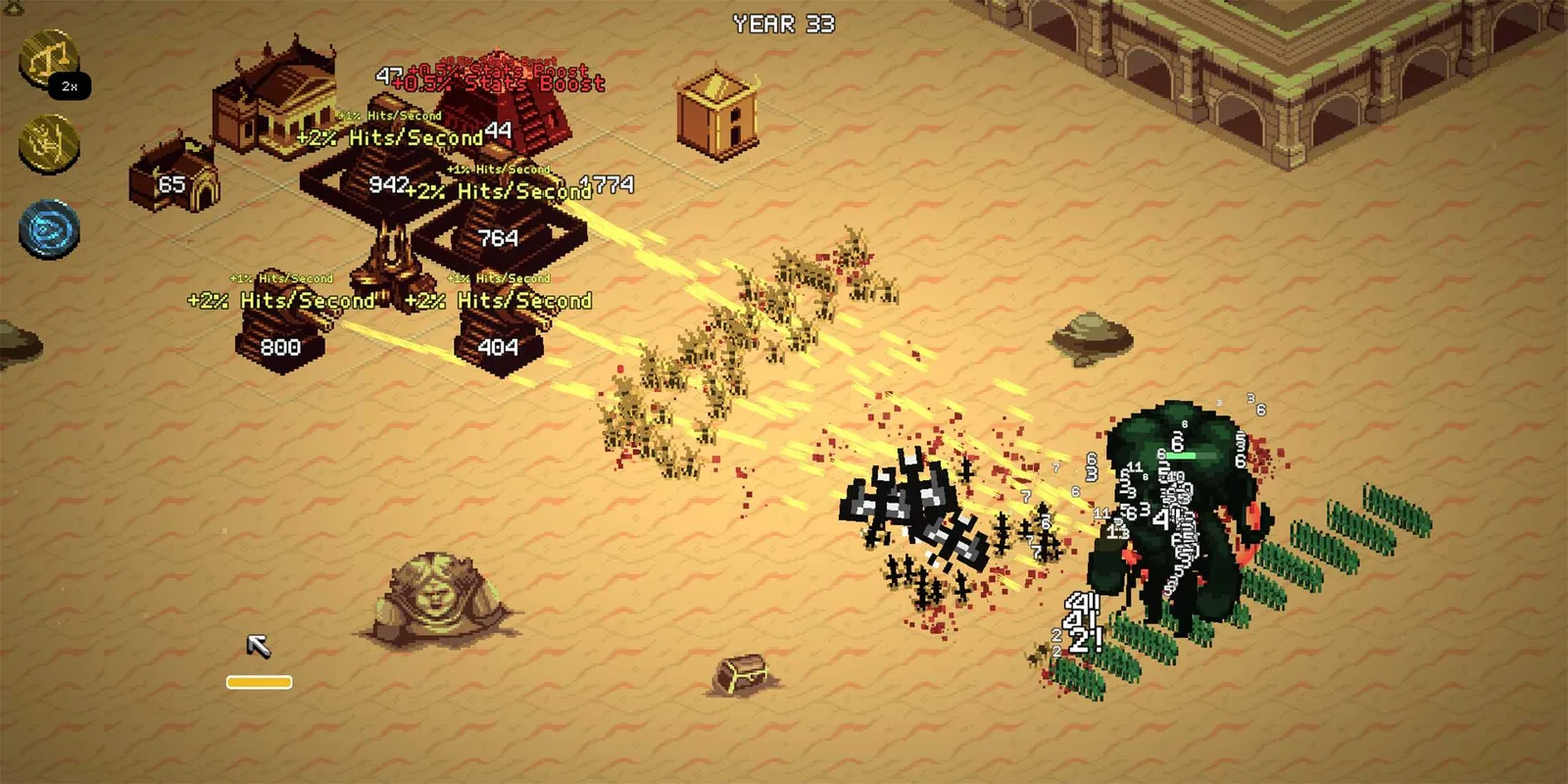
Layout reference only; use current card previews for stats and effects.
Blacksmith supports nearby attack damage, while Quarry offers a tower-oriented damage route from Stone. Beacon helps speed. Choose according to what the battle shows: slow attacks, weak hits, or too little time before enemy contact.
Avoid equating an enormous tooltip speed with an automatic win. Earlier community claims about speed caps and simulation behavior do not provide a current universal threshold. Observe targets defeated and attacks delivered. If the screen is failing, spend on protection rather than adding more speed to a tower that barely gets to act.
Decide how much gold the frontline needs
Mercenary population depends on the gold you hold. The post-rework baseline is nine gold per unit, with your current modifiers reflected in the preview. Before shopping or repeated rerolls, inspect whether the resulting reserve still supports the army you intend to field.
There is no universal wallet target for every Greed run. Troop levels, health support, enemy damage, and your other screens all change what a sufficient army looks like. Use the battle and the preview instead of copying a fixed reserve from a screenshot.
A purchase is worthwhile when its improvement compensates for the lost troop numbers. A crucial tower upgrade may do that. A card with no available recipient probably does not. Make the trade explicit so that spending does not quietly undermine your own defense.
You can also move away from a Mercenary-dependent screen when the reward pool offers a suitable alternative. This gives more freedom to spend, but the replacement must survive and occupy enemies. Removing the gold dependence is useful only if the new frontline actually works.
Use Vault as a supported investment
Vault now levels automatically every year, giving it a built-in long term growth route. Place it when your existing combat core can afford the occupied plot. Early placement offers more time, but it is not worth sacrificing the only useful unit to make room.
Overwork now applies to Vault. If that decree is available, evaluate its benefit across the support buildings already in your kingdom. A decree helping several useful systems may offer more practical value than one chosen only for a distant gold target.
Speculation raises the Vault level cap, but a cap increase is not the same as an immediate defensive improvement. Choose it when the run can live long enough to use the additional growth. Patch #30 removed excessive Vault-level interactions involving Overhaul and Speculation, so an old infinite leveling demonstration should not determine the plan.
Greed also receives value from shops because the economy can fund focused upgrades. Use that advantage to repair missing damage or frontline strength. Continually adding Vaults without buying combat power can leave you richer and weaker than the enemies you must fight.
Make demolition serve the build
Mortgage can turn an expendable plot into gold. Offering and Overhaul provide different destruction-based opportunities when their source decks are available. Before using any of them, inspect what is removed and what the current card actually gives you.
A temporary Vault or unwanted troop may be a reasonable target. A support building maintaining the carry's growth is not automatically expendable merely because its direct attack is small. Count its connections as part of the cost.
Overhaul can improve random plots, so a plan aiming its value at one target needs to consider the other eligible plots on the board. Do not destroy half a functional army in pursuit of a perfectly concentrated reward unless the present run can afford that setup.
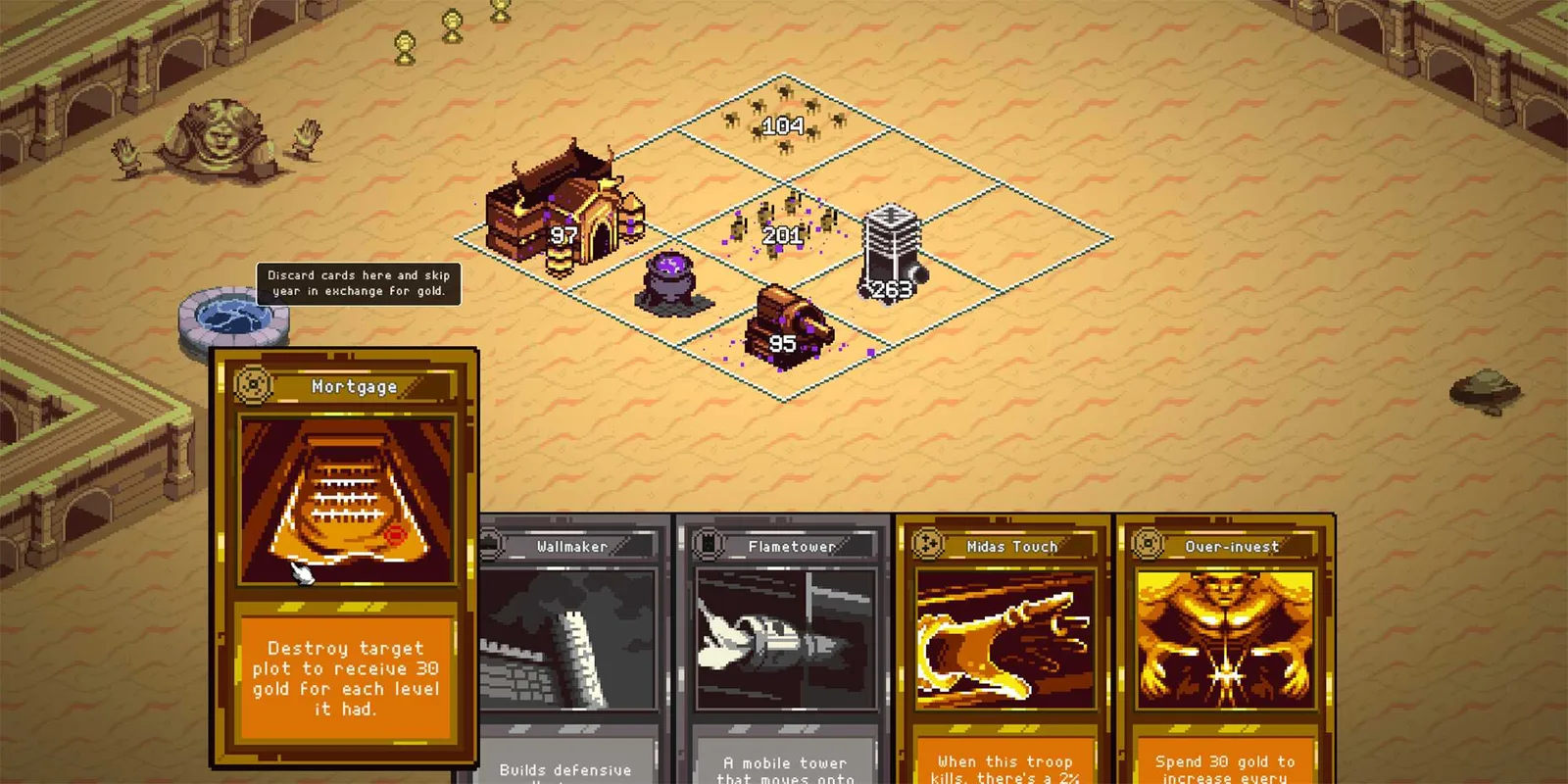
Destroy only a plot the remaining army can afford to lose.
The practical sequence is to identify the replacement first, check that the remaining army survives, and then destroy the obsolete piece. Demolition is a resource conversion, not an end in itself. A gold gain should create a clear purchase, preserve troop numbers, or accelerate a useful tower.
Borrow support that fixes the current gap
Nature offers Forest for troop health and Clone for a relevant copy opportunity. Nothing offers Blacksmith, Farm, Wildcard, and direct combat options. Stone can provide Quarry for towers. Spells can provide support for enchantment development when you have troops suited to it.
Borrow one useful system at a time. A Library plan requires valuable enchantments and recipients; a Forest needs an appropriate troop connection; Quarry matters when towers do the damage. Taking every promising card can occupy all the plots before any support relationship works.
Mangler from Blood is a conditional alternative when you can afford to feed it. Its current form summons meat trolls and gains health from destruction under Patch #31. That does not make it a free addition: check whether its consumption weakens the Mercenary screen you need to protect other attackers.
If a borrowed card supplies immediate missing power, it may deserve priority over another Greed card. Your kingdom does not need to remain faction-pure. It needs a functioning damage source, a surviving screen, and a growth route compatible with its economy.
Select decrees for the board you have
Prefer effects that improve a present engine. Health can help a fragile Mercenary frontline. Support activation can strengthen useful buildings. Income effects can grow Dispenser, but they need a working combat core that benefits from the money.
A fixed old perk or decree recipe is risky because the rules and available options have changed. In multiplayer, the current season's decree pool is visible in the lobby and rotates under Patch #31. Read it before deciding that a particular effect is mandatory.
After a battle, reassess the same chain: income enters the economy, the economy supports troops and upgrades, and the army protects its damage source. Repair whichever link fails first. Greed becomes manageable when spending, saving, and placement all point toward the same combat plan.