
A practical King of Time build starts with a protected Warper and useful stat or enchantment support. Adrenaline improves the attack-speed growth route, while available defensive support keeps the valuable summoner alive. Portals can provide more development opportunities, but they should support a working army rather than replace its opening combat power.
This guide follows version 0.9.8. Patch #31 rebalanced Hourglass's late-game attack-speed progression, fixed the Wise and Amplifier freeze, and improved Orbiter's receipt of pre-applied enchantments. Old portal loops and extreme Hourglass screenshots therefore do not establish a guaranteed current build.
Choose between summoner growth and tower investment
Time offers several appealing systems, but they compete for your first cards and plots. Warper provides a summoner-based combat route. Hourglass offers a tower-oriented growth plan. Portals and support pieces can develop either route, but they do not supply a complete opening army on their own.
| Route | Core requirement | First support priority | Reason to delay it |
|---|---|---|---|
| Warper | A summoner that survives long enough to contribute | Health, protection and useful enchantments | The opening does not provide Warper or screening |
| Hourglass | A tower with time and protection to develop | A screen and appropriate tower support | Immediate enemy pressure exceeds the current defense |
| Portal development | A working army plus usable portal opportunities | Growth that benefits from the extra time | Repeated setup replaces necessary combat upgrades |
| Orbiter support | Useful neighboring troop enchantments | Correct adjacency and a protected combat role | The surrounding troop system is still incomplete |
Begin with the route your hand can actually support. Do not hold out for a theoretical portal engine while fielding an unsupported troop that cannot survive. A temporary off-faction unit can be the bridge toward the desired Time system.
Protect Warper before maximizing its output
Warper's summons depend on the summoner remaining useful during battle. If it dies in the opening exchange, future attack-speed growth does not have time to pay off. Start by identifying the enemy that reaches or targets it.
A frontline can occupy ordinary approaching enemies, but not every threat respects that screen. Thieves can reach the backline, and distant-targeting ranged units can threaten valuable summoners. Inspect the actual battle instead of assuming a rear placement guarantees safety.
Give the Warper the defensive support that fits the failure. Health growth helps a recipient survive damage it would otherwise outlast poorly. Steel Coat protects against incoming damage instances. More troop presence can create time, but a fragile crowd may not solve an attacker that directly reaches the summoner.
Keep the earliest improvements focused. Developing one protected summoner is easier to assess than splitting limited cards among Warper, Orbiter, Hourglass, and several support buildings before any attacker works.
Use Adrenaline with a surviving recipient
Adrenaline provides a growth route during combat. It is relevant to Warper because attack opportunities influence summon production, and its value grows when the summoner remains active. A recipient eliminated immediately cannot exploit that development.
Brutal changed in Patch #30: all your troops start with an Adrenaline stack, rather than the narrower old effect. That alters which recipients benefit in your equipped loadout. Read the current preview instead of using an old Warper-only instruction.
Library from Spells can develop enchantments on a connected troop. When available, place it beside the recipient whose survival and output define the build. Adding useful protection and speed development to the principal summoner gives the support a clear purpose.
Do not introduce unnecessary enchantments solely to increase a count. Choose effects that contribute to the current army. A Library investment is more attractive once your opening survives; immediate troop strength or protection can matter more when the next battle is unsafe.
Evaluate the summons and the summoner separately
A summoning build has two points of failure. The Warper may die before producing enough units, or the units it produces may fail to contribute enough before the enemy reaches the rest of the army. Those require different repairs.
If the Warper disappears early, prioritize its survival and the screen. If it remains active but the army cannot finish enemies, improve the useful stats or effects supplied to the summoning system, or add a complementary damage source.
Avoid assuming that a very large summoned population is automatically sufficient. Area damage, enemy targeting, and the speed at which useful attacks occur influence whether that population wins the fight. A second summoning plot can add output, but it can also consume space you needed for protection.
Current patch fixes make old bug reports a poor basis for a permanent strategy rule. Patch #30 added safeguards for battles involving invisible Warpers. Evaluate the fresh run's behavior rather than interpreting every weak result through an old freeze or targeting report.
Place Amplifier where its effect reaches useful plots
Amplifier is a support investment. Its placement should be justified by the affected plots, rather than by an abstract desire to stack every growth source. The current interface highlights affected plots while placing Amplifiers, which helps you check the connection before committing.
Patch #31 fixed a critical freeze involving King of Time, Wise, and Amplifiers. That combination no longer needs to be excluded solely because of the old bug, but the fix does not prove it is the strongest current opening. You still need a viable army around the support.
A support plot can cost you immediate combat power. If placing it prevents you from fielding the only useful frontline or damage source, delay the investment. When the core already works, amplification can become a reasonable way to improve its existing growth.
Use the preview and affected-plot highlights to compare placements. A theoretically high number of recipients is less useful than reaching the one or two plots carrying the build. Keep the relationship readable so later cards do not accidentally break it.
Add Orbiter to a useful enchantment neighborhood
Orbiter interacts with neighboring troop enchantments. Patch #31 specifically makes it gain enchantments when an adjacent troop is placed with pre-applied effects, such as an enchantment supplied by Brutal. That changes how you can establish the support relationship in a fresh run.
The adjacency is a reason to plan the neighborhood, not to populate it randomly. Put useful troops beside the Orbiter and consider what their effects actually contribute. An enchantment transfer with no meaningful offensive or defensive result is not a complete plan.
Destructive now gives forty percent per stack in Patch #31, superseding the earlier Patch #30 value. Use the current perk text in your build rather than mixing both descriptions. A corrected number still requires an Orbiter that has a useful role and survives its encounters.
If your present army depends on Warper, treat Orbiter as a conditional addition. Do not remove the only screen or Library connection merely to create another effect transfer. The support should strengthen the existing core or provide a clearly missing damage job.
Use portals to develop an engine already in place
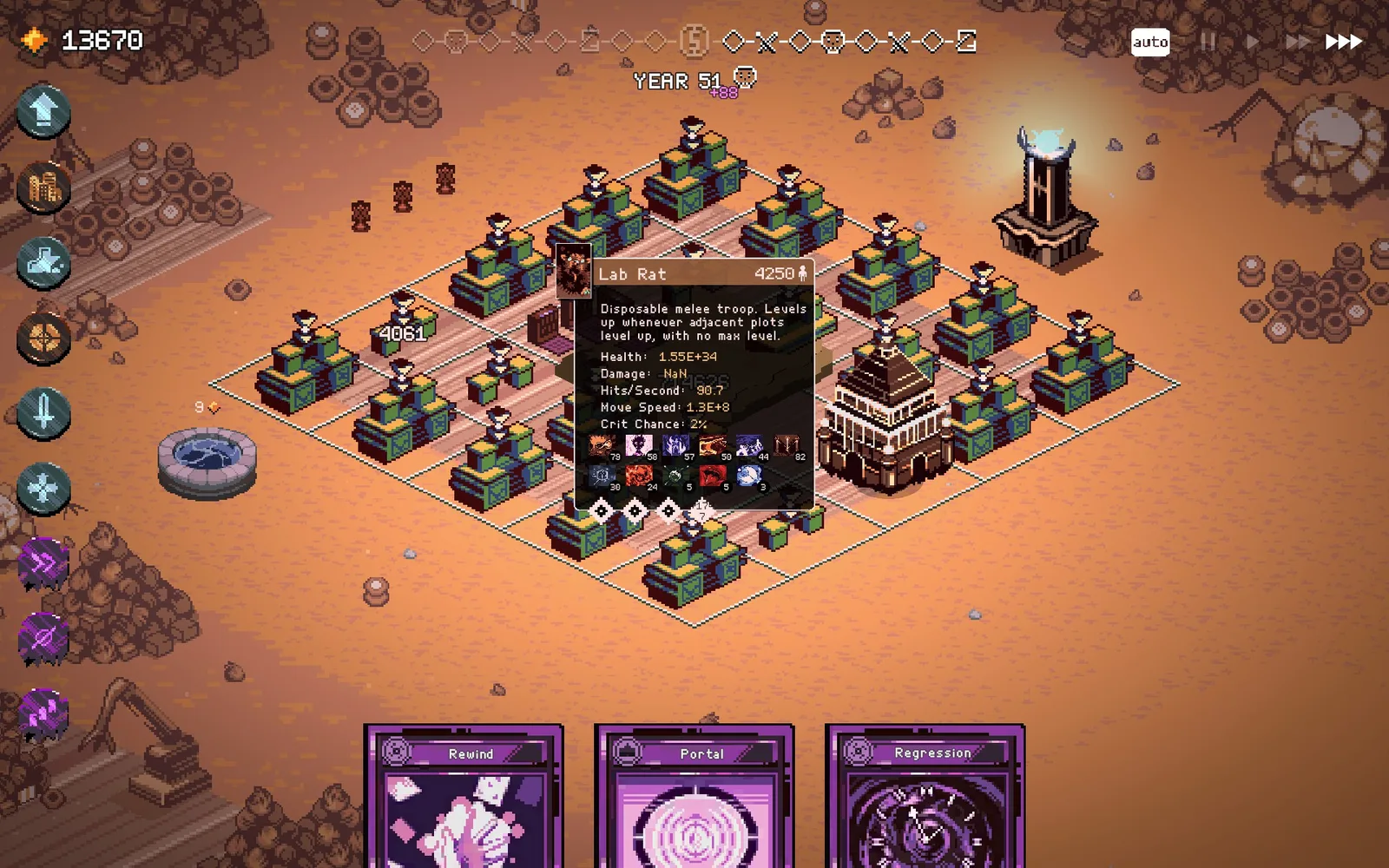
The cards identify a time-development route; this historical NaN readout is not proof of a working current loop.
Portals can rewind time and create opportunities for further development. This makes them attractive alongside systems that benefit from additional turns or battles. However, repeated portal setup has a cost when the army needs immediate upgrades to survive.
Before committing to a portal sequence, identify what improves during the extra time. A placed growth source, a developing enchantment recipient, or a useful support cycle gives the rewind a purpose. Returning to earlier years with no working growth system can simply lengthen a weak run.
Avoid an exact guaranteed loop recipe. Old community plans rely on particular perks, card sequences, and historical interactions, and the supplied material does not establish that every such chain is currently reproducible. Use the current card descriptions and available hand to judge whether your run can continue the development route.
Portal development has a stopping condition: traveling back thirty-three years breaks the time continuum and transfers you to the nearest boss fight. Prepare your army for that forced encounter before relying on further rewinds. Patch #31 fixed a soft lock at this boundary; it did not remove the boss transfer or announce unlimited time travel. In multiplayer, defeating all remaining enemy kings also progresses the run to its final battle. Portals can help develop a build, but cannot promise unlimited safe growth or avoidance of the ending.
Invest in Hourglass with a damage and protection plan
Hourglass can serve a tower-oriented route, but its late-game attack-speed progression changed in Patch #31. Old claims about reaching a particular speed, year, or infinite damage value cannot be carried directly into the current version.
As with any tower, protection determines useful firing time. A strong displayed attack is not enough if the enemy reaches the tower before it contributes. Retain a frontline or control system that gives the tower opportunities to attack.
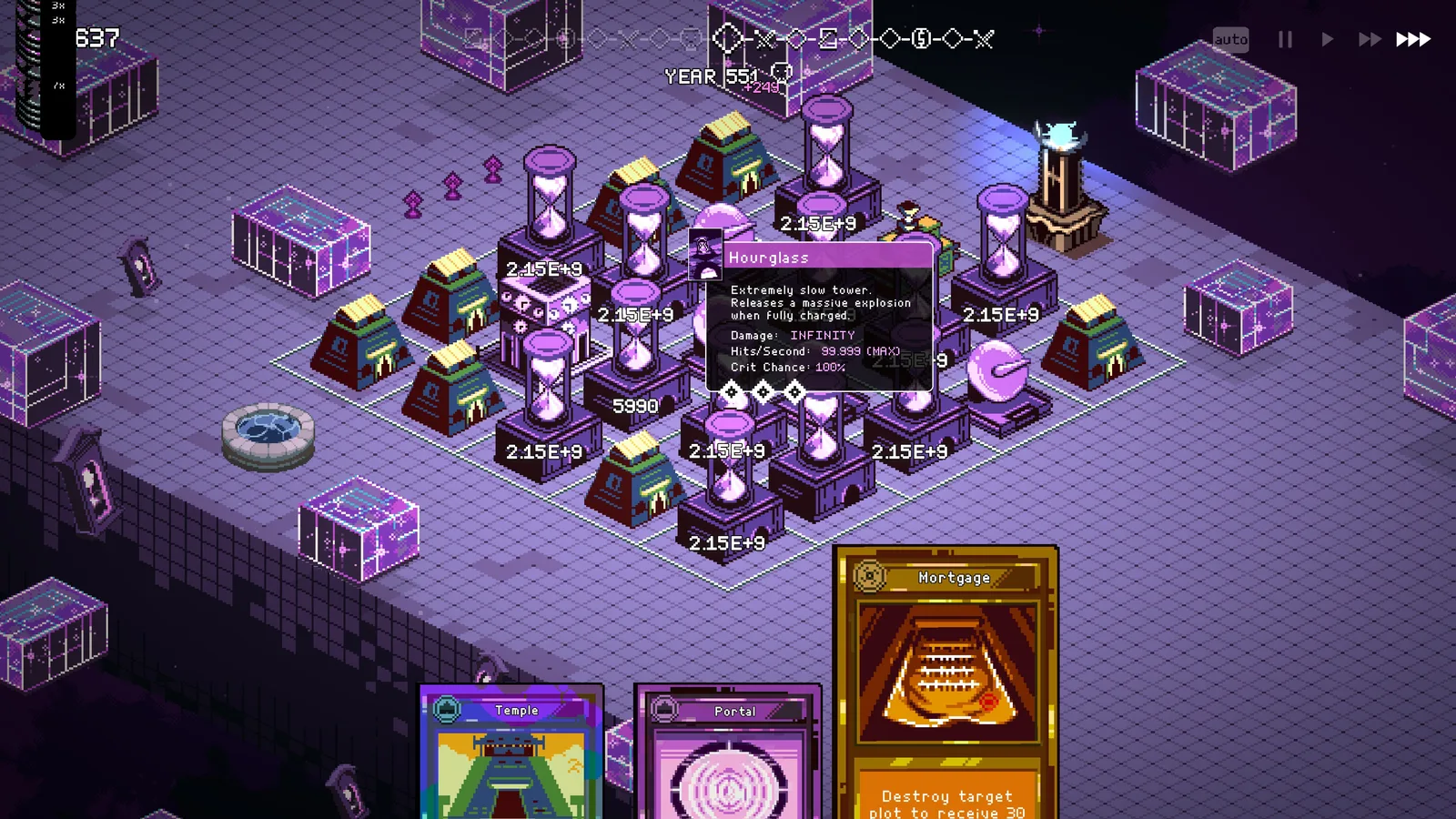
Hourglass is identifiable here, but the historical INFINITY readout does not establish current damage or progression.
Choose support according to the present bottleneck. Speed support helps when attacks are too infrequent. Damage support helps when the hits are insufficient. Control can help when enemies approach too quickly. Do not keep adding the same multiplier without observing which problem remains.
If Hourglass appears after a Warper core is already functioning, it can be a complementary attacker rather than a reason to demolish the summoner system. A late pivot is worthwhile only if the new route develops enough immediate value to replace what you remove.
Borrow cards that bridge the opening
Nothing offers straightforward troops, Steel Coat, and flexible upgrades. Spells offers Library and other enchantment support. Greed can provide Beacon for speed. Nature can offer population or health support. Choose the tool that repairs the current army rather than assembling every attractive off-faction combination.
Warper protection should be judged against the actual opponents. An enemy that reaches the summoner directly may require a different answer from one whose ordinary frontline slowly overcomes yours. Avoid assuming that more damage solves both.
Spend rerolls with several acceptable outcomes. A viable screen, summoner duplicate, or current defensive effect can all be productive if the opening is unstable. Save more elaborate support development for the point when the core reliably reaches another reward.
Review each failed battle through the sequence that matters: the screen buys time, the summoner remains active, useful summons contribute, and the growth system improves the next fight. Repair the first broken step. That gives Time a practical plan even when the desired portal or tower route does not appear.