Plan a build by choosing its damage source, protection, growth engine and realistic card routes before drawing the finished kingdom. This page is a static planning guide. It does not run combat, calculate a win chance or provide a saveable interactive board. Use it to turn a collection of strong cards into a sequence you can actually play.
The plan should match version 0.9.8, Patch #31. A fan-made strategic planner exists, but its captured interface showed seven named kings and two coming-soon positions; that capture does not establish complete current coverage or a battle simulator. Whether you use a separate board tool or simple notes, current in-game descriptions govern what the cards do.
Write a build brief before selecting cards
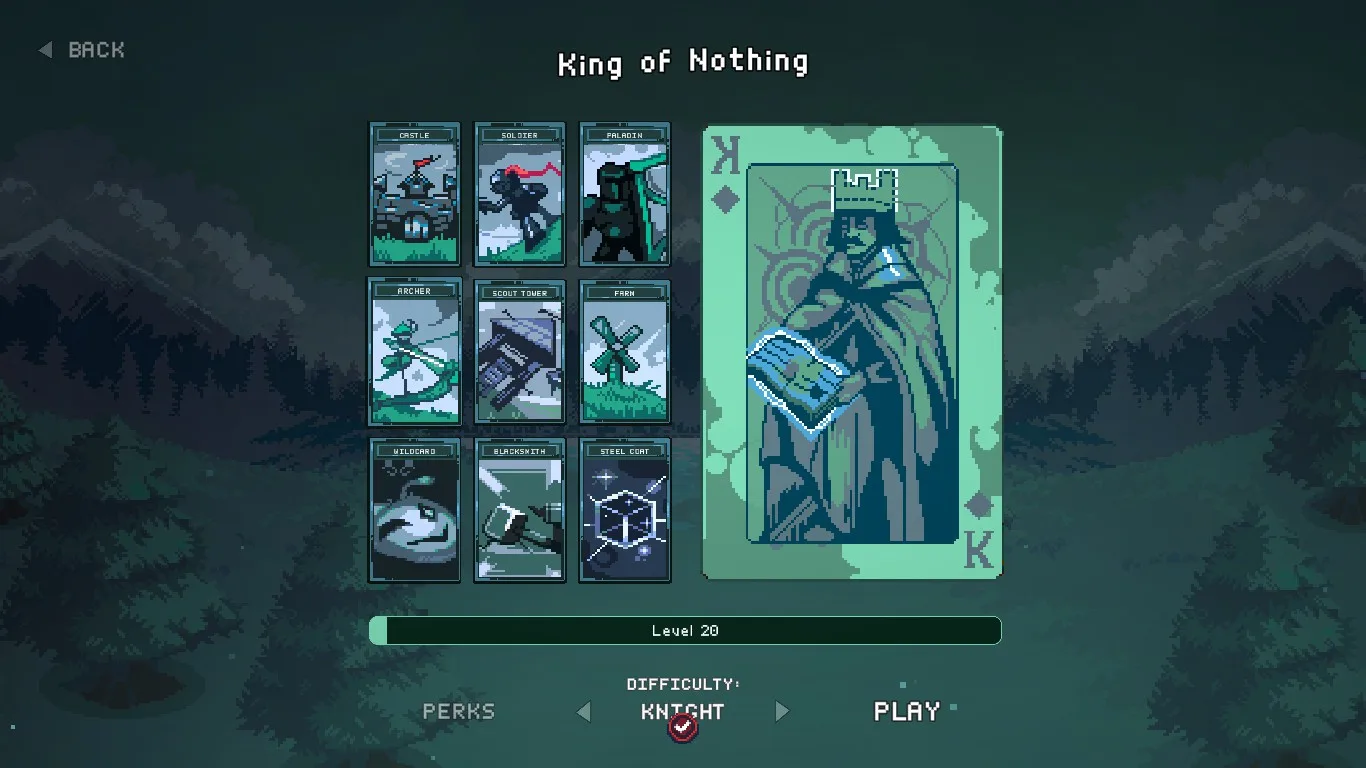
Ruler identification screen; this older illustration may show a previous deck arrangement. Read current tooltips for card effects.
Start with an objective that can be checked. Finishing an ordinary campaign, learning a king's mechanic and exploring longer-term scaling are different tasks. A plan optimized for an elaborate future engine may not supply enough early strength for a campaign finish, while a straightforward winning kingdom may not be intended for extreme Endless play.
Write the main carry next. It should be a troop, tower or base role you can explain: dealing direct damage, clearing crowds, attacking a backline or supplying a special combat effect. Naming the carry forces you to identify which part of the board actually defeats enemies rather than assuming every support card contributes equally.
Add the protection job. That can be a durable troop, a wall, a survival enchantment or another specific way to keep enemies from reaching the base before the carry acts. Then add the growth job: repeated damage support, health support, income, enchantment development or upgrades. You now have a build concept rather than a shopping list.
Finish the brief with a failure condition. For example, the plan fails if the frontline disappears before the attacker fires enough times. This gives your next reward decision a test. An extra damage card may be attractive, but the brief tells you whether it addresses the actual risk.
Use four planning fields
| Field | What to write | What it prevents |
|---|---|---|
| Damage source | The plot expected to remove enemies | A kingdom composed mostly of support |
| Protection | The plot or effect buying combat time | A powerful carry dying before it contributes |
| Growth | The effect improving the plan across years | A board with no development beyond its opening |
| Access route | Starting deck, rival loot, shop or special reward | Assuming every chosen card will arrive on demand |
The access field is especially important. A finished board can contain an excellent combination that the current run cannot realistically assemble in time. A normal reward choice is not a catalog from which you freely buy every card. Build the immediate plan from available cards, then treat the preferred finished board as a direction.
Do not add a separate number for every speculative benefit. If the current materials do not establish a formula, use a role description and inspect the in-game preview. A planning note saying that Blacksmith should reach the chosen attacker is useful. A fabricated damage-per-second forecast is not more precise simply because it contains a number.
Separate the opening from the finished engine
The opening needs a working fighting board. The later engine needs recipients, support and time. Those requirements overlap, but they are not identical. A card useful after several growth cycles may still be a poor first investment if no plot can hold the incoming enemy.
Create two columns in your notes: what you can play now, and what would improve it later. Put the current troop or tower in the first column. Put desired support, upgrades and off-faction additions in the second. Move a card into the current plan only when it is available and has a productive placement.
This prevents a common planning failure: preserving an ideal empty position while sacrificing the entire early kingdom. An adjacency spot has value because of the effects it may receive, but it should not override immediate survival without a clear reason. A temporary defensive plot can be correct even if you eventually intend to replace it.
The same principle applies to a hand holding future cards. If a card cannot yet be used well, decide what must happen before it becomes useful. That requirement might be another recipient, an unlocked plot or a direct upgrade. If the requirement is unlikely to arrive before the next dangerous fight, revise the plan instead of insisting that the finished diagram is inevitable.
Record dependency order
An engine is a sequence, not just a set of names. A Library needs a useful neighboring recipient carrying enchantments. A Recycler needs meaningful adjacent plots and cards thrown into the pit. A Demon Altar needs allied deaths feeding it. These are different dependencies, and each can fail if the receiving plot is missing or the trigger costs more than the benefit.
For each special card, write one dependency sentence. For Library, identify the intended troop and enchantment. For a sacrifice, identify the plot lost and the plot improved. For a population effect, identify which troop's count matters. This creates a plan you can evaluate without pretending to simulate the fight.
If a sequence contains several dependencies, prioritize the one that creates immediate value. Building all the triggers before any recipient leaves a decorative engine. Creating a recipient without protection leaves a fragile one. The working order is the shortest path from your existing board to a stronger next battle.
When a reward changes the sequence, rewrite it. A different useful attacker may make an old preferred recipient unnecessary. Adaptation is part of planning in 9 Kings. A plan that cannot absorb a better card is too rigid for a game whose rewards and rival decks change across attempts.
Keep placement notes tied to the build
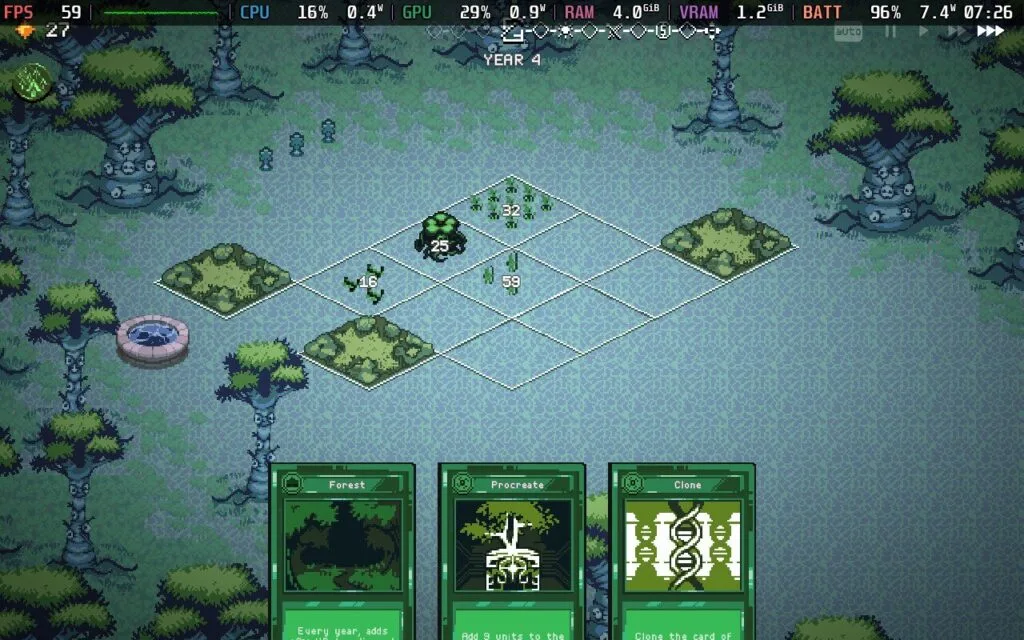
A small kingdom leaves room to plan support around the available troop plots.
Use the board to record relationships rather than only exact coordinates. Mark which support must touch the carry, which defensive plot protects it, and which space can hold a temporary card. The ordinary opening grid is small, so a placement that preserves useful adjacency often matters more than the total number of occupied plots.
A Blacksmith intended for a troop-and-tower plan should reach valuable damage recipients. A Forest intended for a durable unit should reach that unit. Quarry is different because its tower support does not require the same local arrangement. Reading the actual scope of an effect keeps you from solving an adjacency problem the card does not have.
This page does not provide a universal optimal layout. A tower-focused board, an upgrade chain and a moving Nomads engine can need different relationships. The point of a build planner is to identify those requirements before you commit a valuable plot, then revise them as the run reveals more cards.
Mark investment that is expensive to abandon. A heavily developed recipient may be less replaceable than an unbuffed temporary card. If a plot-clearing tool becomes available, use the plan to identify what you can safely remove. Clearing space is useful when it creates a stronger engine, not merely because the finished board looks tidier.
Plan card routes without promising rewards
Your starting king establishes the initial toolkit. Rival loot introduces additional cards, and shops can add another route. Diplomacy can favor rival kings whose decks contain useful tools, but it does not guarantee a particular card on the next reward screen.
Write desired imports as categories first. A damage plan may need attack speed, protection or a flexible upgrade. Then note named cards that serve those jobs. This makes the plan resilient: if the preferred card does not appear, another card can still address the missing requirement.
Use an explicit shop priority. Before spending gold, identify the improvement that matters most. Repeated rerolls without a target can leave you unable to buy a good card when it appears. A planner should help you stop spending once the urgent job is filled, rather than encourage chasing every optional component.
For Greed, consider the reserve after spending because Mercenary strength depends on gold. For other rulers, consider whether the purchase creates immediate combat value or a dependency you cannot yet satisfy. In either case, the correct comparison is the board after the transaction.
Update plans for reworked cards
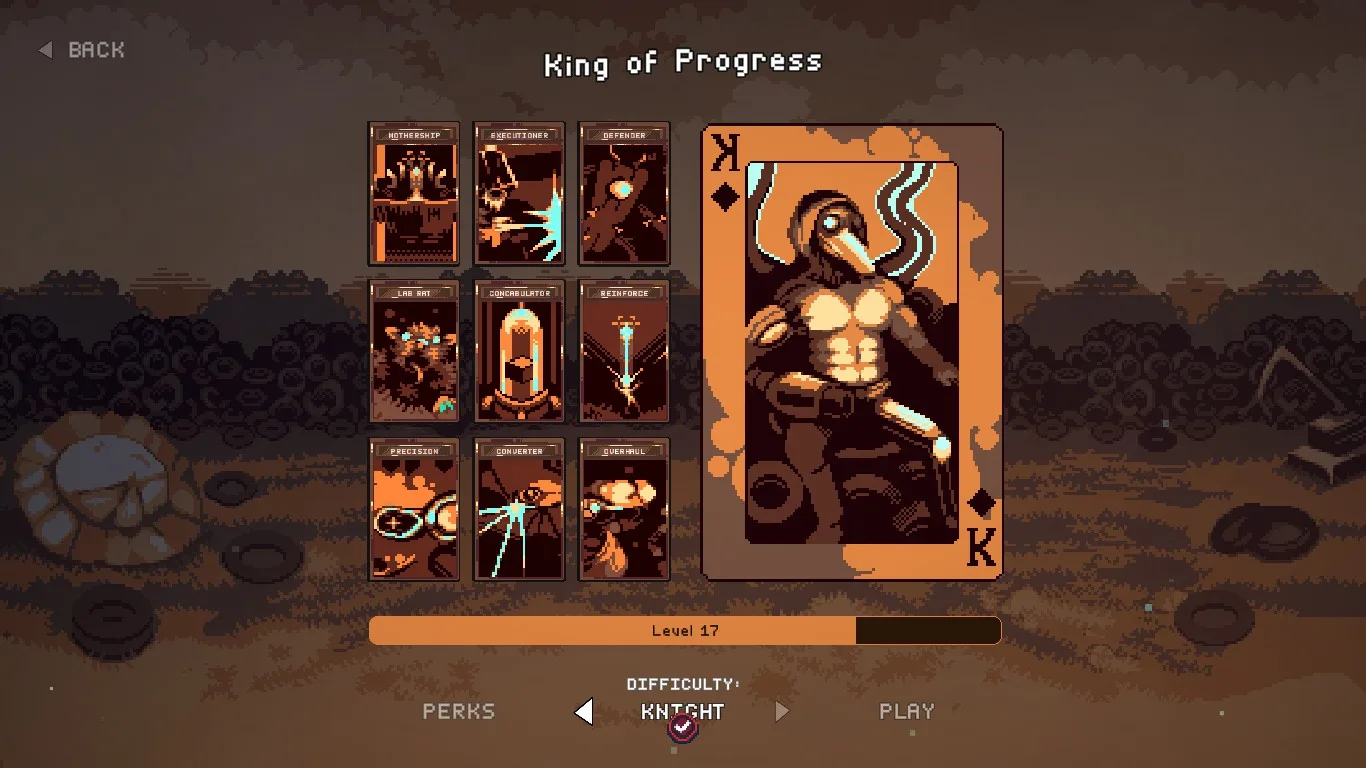
Ruler identification screen; this older illustration may show a previous deck arrangement. Read current tooltips for card effects.
Progress is a clear example of why an old build diagram can become misleading. Reinforce now adds health during battle and can heal above maximum HP. It no longer supplies the upgrade-triggered attack effect described in older guides. Recycler supplies a current pit interaction with adjacent growth, and belongs in plans built around discarding cards.
Blood also changed. Mangler now summons meat trolls, Pagoda summons Ghosts, and Cemetery uses skeleton interactions. Oblation belongs to the current pit-based deck design. A diagram labeling those roles with an old Vampirism effect or treating every summon as an Imp does not describe the present build.
Greed's Vault automatically levels each year, and Mercenaries use the current gold relationship rather than the older fifteen-gold figure. Scout Tower gained projectile scaling per level, Trebuchet gained area damage, and Trapper acquired stun and a larger unit count. These changes can affect both the opening and the reason for choosing support.
Patch #31 also fixed the broken Surge and Library interaction and rebalanced Hourglass late-game speed progression. Keep a version note beside a saved plan. After an update, verify the interaction that actually makes the plan work before trusting the rest of its diagram.
Decrees belong in a conditional branch
A decree can improve a working build or create an opportunity for a different one. Plan preferred choices around the recipients already on the board. Overwork is meaningful when support buildings are doing useful work; a tower-speed effect matters when your towers are an important damage source.
Do not write a decree into the opening as a guaranteed event outcome. Instead, record a preferred branch and a fallback. If the expected decree does not appear, the fallback should preserve a functioning board rather than require restarting every attempt by default.
For multiplayer, inspect the current decree pool in the lower-left lobby. Patch #31 introduced seasonal rotation, so a saved plan relying on a particular decree may not be available in the current season. Remove that branch from the plan when the pool excludes it; spending toward an unavailable component cannot solve the build.
The same restraint applies to special cards. A rainbow reward can transform a plan, but the ordinary opening should not depend on a rare future card that supplies its first real damage or protection. Place special-card opportunities in the improvement column until the card actually exists in your hand.
Review the plan after combat
Use the battle result to update one priority. If the carry survived but enemies remained, compare damage, attack cadence and target selection. If the carry disappeared early, compare protection, troop count and positioning. If the base was reached while unused support filled the board, simplify the engine.
Current card stats and upgrade previews make that inspection more useful. In multiplayer, the post-game kingdom review added in Patch #31 also lets you inspect your completed board and rival builds. Treat another kingdom as evidence of an arrangement that existed in that run, not proof that every card sequence in it is reproducible from your current opening.
A useful final plan consists of a carry, protection, growth, available routes and a next improvement. That is enough to guide decisions. Add detail only when it changes a card choice or placement. The planner has done its job when you can explain the next play and verify its effect, even if the finished kingdom differs from the diagram you first imagined.