Build King of Blood around Demon Altar and a supply of expendable troops. Imps hold enemies in place, Cemetery adds summons, and allied deaths develop the Altar's Demons. Use Pagoda, Oblation, and carefully chosen destruction effects to expand that system. Protect the Demons while the disposable part of the army creates time and growth.
This guide applies to version 0.9.8. The current Blood deck differs substantially from launch guides: Oblation replaced Vampirism, Pagoda summons Ghosts, Cemetery summons Skeletons, and Mangler summons meat trolls. Demon Altar also received a damage-growth buff in Patch #30. These recommendations describe a conditional build, without promising a particular difficulty clear.
Separate the screen from the carry
The army has two important jobs. Expendable troops occupy enemies and produce allied deaths. Demons are the valuable damage investment you want to remain alive while that happens. Treating every troop as an equally important permanent carry obscures this relationship.
| Piece | Main job | Decision it creates |
|---|---|---|
| Imp | Provide a numerous expendable troop screen | Improve numbers or direct damage when the opening needs it |
| Demon Altar | Supply Demons that benefit from allied deaths | Place early, then protect its combat contribution |
| Cemetery | Add Skeleton summons and destruction interactions | Connect it to troops you intend to use in the engine |
| Pagoda | Summon Ghosts with destruction-based count growth | Decide which troop destruction is worth the cost |
| Oblation | Increase troops through pit use | Sequence discards while retaining necessary cards |
| Mangler | Consume units and summon meat trolls | Balance its feed against your remaining screen |
| Bomber | Deliver an explosion and a disposable troop role | Use when the target and survival path suit the explosion |
Do not remove the screen as soon as the first Demon looks strong. A valuable summon can still disappear when it becomes the only target. The build works when expendable units create enough time for the damage source to contribute.
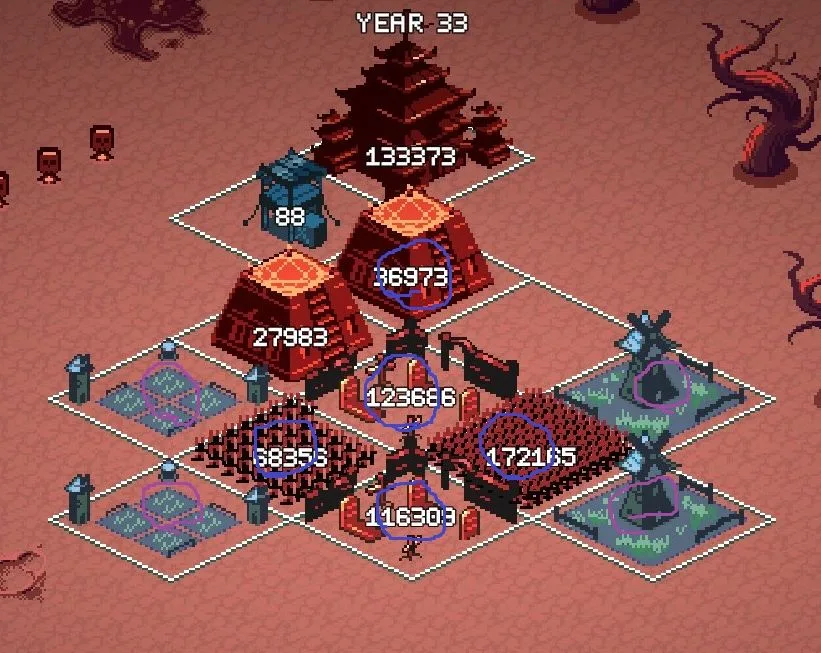
Layout reference only; use current card previews for stats and effects.
Establish a small working engine
Begin with a usable troop and an Altar if available. A Demon Altar placed early has more opportunities to benefit from the run's deaths, but a board containing only future scaling can still lose its opening battles.
Add Cemetery where its adjacency supports troops you actually use. In the current version, its summons are Skeletons. A diagram from an older guide may show Imps and use the old name or effect; recognize the layout idea without copying those obsolete descriptions.
The opening does not require every Blood card. A working troop screen, one Altar, and a useful Cemetery connection can be more coherent than a board divided between Altar growth, Mangler consumption, and an unsupported Bomber plan.
If Altar is not in the first hand, keep enough immediate power to reach it. Take a useful duplicate or a temporary damage unit rather than spending every reroll while your current army remains weak. The Altar engine needs an opening that survives long enough to start.
Make allied deaths useful without forcing a loss
Demon Altar benefits when allied units die. That creates a reason to field expendable troops, but not a reason to lose the battle intentionally. You want the screen to absorb enemy attention while the rest of the army completes the fight.
Observe whether troops are dying in a productive sequence. If they disappear at once and leave the Demons exposed, you may need more screening, another damage source, or a better balance of frontline and summons. If nothing dies and the engine barely develops, inspect whether the army has become too dependent on durable troops that do not serve its intended growth.
Do not follow old upgrade timings as mandatory rules. Earlier guides prescribe specific years for Altar levels to slow battles and collect deaths. Your actual difficulty, patch, opening, and opponent determine whether that delay is safe. Upgrade when the present fight requires it.
The current Altar display also changed. Patch #30 makes its buff calculation show a raw gain rather than the old percentage of original base damage. A smaller looking number in the tooltip does not establish a nerf; the patch increased the damage gained through deaths.
Use Cemetery's battlefield and board interactions
Cemetery now has a battlefield summon role and a passive interaction with adjacent troop destruction. Destroying a troop plot beside it can create a Skeleton plot in the vacated location. This allows a destruction decision to affect the army that remains on the board.
Placement matters twice. The Cemetery should connect to troops relevant to its battle effect, and any planned destruction target must occupy a suitable adjacent plot. A diagonal target is not a substitute for the cardinal adjacency the effect requires.
Pile of Bones provides another current interaction. Placing it beside Cemetery creates a Skeleton troop inheriting the Cemetery's stats, with the quantity tied to Cemetery level. Blighted now gives Pile of Bones when Cemetery is placed, which makes that perk a different setup tool from an old generic Blood bonus.
Read the available card description before committing a destruction chain. If you need the original troop to survive the next fight, replacing it with a Skeleton may not be the right trade. The interaction is useful when it supplies a desired unit, activates another part of the build, or converts a genuinely expendable plot.
Grow Pagoda through deliberate destruction
Pagoda summons Ghosts. After the deck rework, its ghost count grows when units are destroyed, in addition to its level-based count. This makes destruction part of the base's scaling rather than an arbitrary side activity.
Sacrifice can improve adjacent plots while destroying its target. Use that relationship when the target is expendable and the receiving plots matter. Check the preview and adjacency so that the value reaches the Altar system, the frontline, or another relevant damage source.
A Pagoda plan still needs an army capable of fighting now. Demolishing every troop to increase future summons may leave the next battle unsafe. Sequence the conversion only after you know what replaces the removed combat contribution.
Pagoda Ghost production became faster in Patch #30, and Diabolical now adds more Ghosts than old advice describes. Use the current perk text for your selected loadout rather than a launch-era Imp count. This is particularly important when you compare how much the base contributes relative to a permanent troop plot.
Sequence Oblation and pit use
Oblation rewards being thrown into the pit by adding units to your troops. Its effect grows as cards are thrown into the pit. That creates a sequencing decision: discarding expendable cards can strengthen the later Oblation effect, but needed cards still have their own value.
Before a discard, identify what you give up. A spare card may be less useful than unit growth for a developed army. A key Altar or a missing Cemetery can be more useful in play than as a pit trigger. Do not throw away the core while chasing a larger effect count.
Recycler from Progress adds another payoff for pit use by improving adjacent plots' damage and health. Pair it with a troop that benefits and place it before the pit actions you want it to support. A Recycler with no useful neighbors does not turn arbitrary discards into a complete build.
Bloodbath, when available, adds damage when Oblation grants units. That can make the population engine contribute offensively. Choose it for a board that will actually use Oblation, rather than treating the decree as a required answer regardless of your hand.
Add Mangler when the feed is affordable
Current Mangler summons meat trolls and retains a consumption mechanic involving adjacent units. The summons interact with summon bonuses and can supply fodder for other Blood systems. Patch #31 also grants Mangler health when it destroys units.
Those improvements make Mangler a reasonable conditional addition, but its feed has a cost. If it consumes the only units keeping enemies away from your Demons, the extra summon system may weaken the overall army. Establish a sufficient screen before investing another pair of plots in feeding it.
Mangler can also be an alternative damage route when your run offers support for it more readily than a complete Altar system. Use the same survival check: enough feed, enough remaining army, and a summon that contributes before the battle turns against you.
Avoid describing Mangler as the old direct artillery tower. Its current summoned units change how support, protection, and battlefield contribution should be evaluated. Observe the meat trolls and the remaining screen rather than judging the build only by a tower attack number.
Choose Bomber and Carnage for specific jobs
Bomber can supply immediate disposable troops and an explosion. Its pathfinding and explosion distribution improved in the deck rework, but the units still need to reach useful targets. If they die before detonation, another copy alone may not fix the enemy matchup.
Carnage adds damage when its recipient dies. It fits a troop plot that will reliably die near useful enemy targets and has enough health for the effect to matter. A faraway or instantly eliminated recipient may not deliver the result you expect.
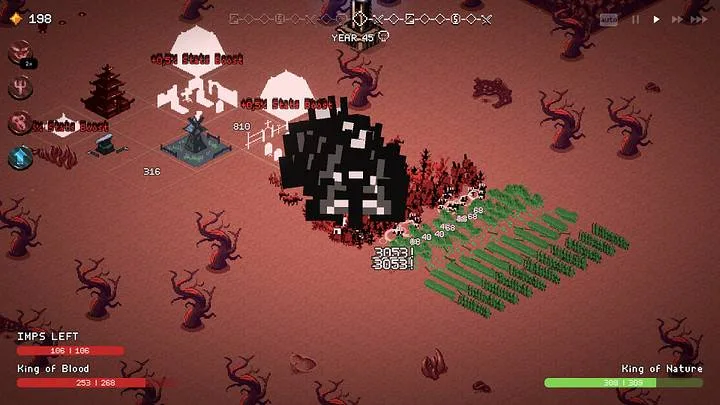
Identify the valuable summons and disposable troops; this image does not establish current damage values.
Neither tool replaces the Altar's need for time. An explosion can help clear a group and create deaths, while persistent screening keeps your valuable summons alive afterward. Use the tools together only when each contributes a clear part of the battle.
Do not recommend Vampirism as the solution to weak Imps in the current deck. It was replaced. If the army needs durability, use current support and available defensive effects, and remember that a healing plan cannot help a troop that is removed before it receives meaningful recovery.
Borrow tools without splitting the whole army
Farm can supply more troops to an adjacent recipient. Procreate offers a population increase. Clone can help reproduce a useful card. Earthworks can create more placement options. These are relevant rewards when the present Altar army can use them without delaying a necessary combat upgrade.
A borrowed damage unit can stabilize the period before the Demons carry fights. Give it an appropriate screen and avoid building a second full enchantment system unless that is actually the easiest repair. The goal is to bridge the opening, not abandon every useful Blood investment.
Defensive support for the valuable summons can be worthwhile later. Judge it through battlefield survival and contribution. Saving a Demon that repeatedly dies early is more valuable than protecting a disposable Imp whose death already serves the engine.
Review the build as a chain: troops occupy enemies, allied deaths develop the Altar, the Demons finish the fight, and current destruction or pit interactions add new value without removing the army you need. Repair the earliest failed link before adding another scaling project.