
Prioritize Blacksmith, Beacon, Wildcard, Clone and appropriate growth support when they improve a working board. Quarry rises to that group for tower kingdoms, while Library, Recycler, Lab Rat and Demon Altar become high-priority cards inside the engines that use them. A high-tier card without a useful recipient can be worse than an ordinary troop that saves the next battle.
These are conditional editorial tiers for selected cards in version 0.9.8, Patch #31. They compare practical roles and requirements, not tested win rates or a complete ranking of every current card. The list deliberately avoids copying obsolete launch-era card effects. Read the placement and downgrade conditions before choosing a reward.
How to use the tiers
S means a card frequently supplies a valuable improvement when its named recipient exists. A means a strong specialist or direct combat option with a clear condition. B means useful but narrower, later, or dependent on the board's immediate problem. None of these labels means that a card should always be placed or always discarded.
The tier belongs to the card's job in your kingdom. Quarry can be excellent among towers and irrelevant among troops. Farm can be valuable for a frontline population and unnecessary for a kingdom doing its work through constructions. A flexible upgrade is good only if the target has room and the resulting upgrade matters.
When looking at rewards, identify the missing role first: damage, protection, growth, space, upgrades or access to another effect. Choose the highest-value card serving that role. This makes the tier list a decision aid rather than a reason to take support that your kingdom cannot use.
S tier for a working recipient
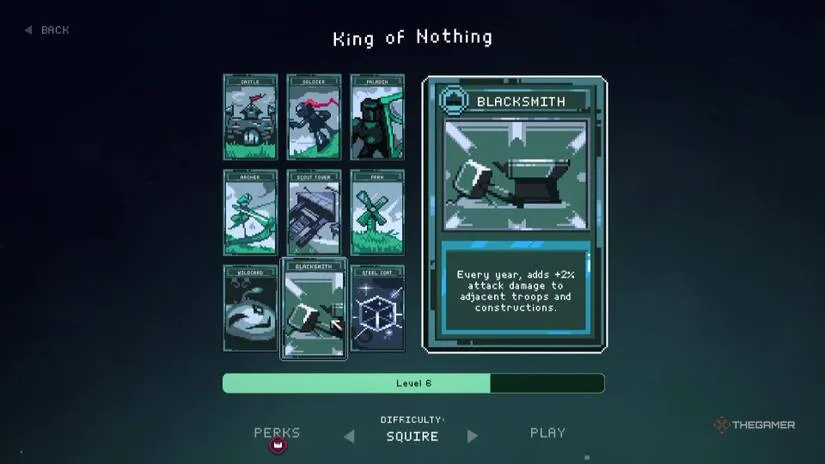
Card illustration for identification; read the current tooltip for updated values.
| Card | High-priority role | Main reason to take it | Downgrade it when |
|---|---|---|---|
| Blacksmith | Recurring damage support | Develops valuable adjacent attackers | It cannot reach useful damage recipients |
| Beacon | Speed support | Improves the cadence of adjacent troops or towers | Existing recipients do not benefit enough to justify the plot |
| Wildcard | Flexible upgrade | Avoids needing one specific duplicate | The useful targets are capped or the next fight needs another role |
| Clone | Copy flexibility | Produces another copy of a placed card | The available target is not worth copying |
| Quarry | Tower damage growth | Supports towers across the kingdom | Your effective force is mainly troops |
| Forest | Troop health growth | Develops durable adjacent recipients | The kingdom's problem is damage or immediate survival elsewhere |
| Farm | Troop population growth | Develops troop count over time | No useful troop recipient exists |
| Earthworks | Space and restructuring | Returns cards and opens adjacent space | The target contains investment you cannot afford to abandon |
Blacksmith and Beacon solve different constraints. A large hit delivered too slowly can leave enemies alive; a fast attacker with weak useful damage can fail for a different reason. Their shared high placement does not imply that you should always choose them in the same order. Watch the battle and upgrade the limiting factor.
Wildcard and Clone earn priority through flexibility. They can help you improve an existing plan without requiring the exact ordinary duplicate you hoped to see. That flexibility has a ceiling: neither is automatically valuable when the available recipients are weak, capped or unrelated to the next battle's problem.
Farm and Forest should be judged by time and recipients. Early placement can create more development cycles, but a support card with future value is not a substitute for a fighting plot. Take the recurring effect when the board can survive long enough to use it, or when it immediately supports the troop already buying that survival.
Earthworks is an especially contextual S-tier tool. It solves access and rebuilding problems, but removing a buffed carry to create a tidy arrangement can lose far more than the returned cards provide. Favor a disposable or carefully chosen target whose removal makes the next kingdom stronger.
A tier for defined engines
| Card | Engine or role | What makes it strong | Requirement to check |
|---|---|---|---|
| Library | Enchantment development | Supports repeated investment in a troop | Useful enchantments on a suitable adjacent recipient |
| Recycler | Pit-based growth | Discard actions develop adjacent plots | Recipients and a sustainable discard flow |
| Lab Rat | Upgrade growth | Responds to neighboring levels beyond ordinary limits | Useful adjacent upgrading and early survival |
| Demon Altar | Summon growth | Allied deaths feed the summon engine | Deaths that create value without losing the kingdom |
| Mangler | Destruction and summons | Consumes units and develops its meat-troll role | Fodder, recipients and a defense left after consumption |
| Scout Tower | Direct tower damage | A recognizable supported construction carry | Damage support and time to fire |
| Paladin | Durable troop role | Gives a frontline a clear defensive identity | Enough damage behind or alongside it |
| Wizard | Ranged damage | Offers heavy individual attacks | Protection and an adequate attack cadence |
| Defender | Defensive and reflection role | Can buy time and punish attackers | Health support and a damage plan that clears the wave |
| Trebuchet | Construction-based area damage | Benefits from a construction-heavy board | A relevant tower plan and defensive time |
These cards can be more important than every S-tier entry in the right kingdom. The lower broad label reflects setup and specificity, not a universal lower ceiling. A stocked Recycler engine is a different object from a Recycler placed beside empty or irrelevant plots.
Library is the same kind of distinction. A troop carrying useful enchantments gives the building something valuable to develop. Without those enchantments, taking Library because of its reputation can leave an unused support plot while the next fight remains unsolved. The valuable choice is the completed relationship.
Lab Rat also deserves a role-based reading. Its uncapped leveling is attractive, but you need meaningful neighboring upgrades and a functioning defense during development. A later reward cannot retroactively create those early cycles. Choose it when your board can supply the trigger, not merely because a historical player reached an extreme displayed level.
A tier can supply the immediate answer
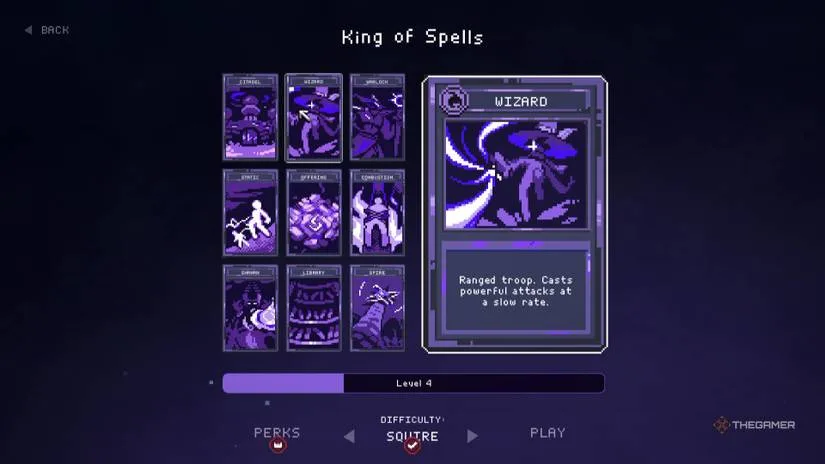
Card illustration for identification; read the current tooltip for updated values.
Direct combat cards remain important even though recurring support dominates many long-term plans. Scout Tower, Wizard or another available attacker may be the correct reward when your support already exists but the board lacks damage. A Paladin or Defender may be the correct choice when the attackers have no time to act.
Do not confuse support potential with current output. The kingdom does not win because its future spreadsheet would contain a strong total. It wins when the attackers available now defeat the incoming force before the base falls. That can promote a lower-ranked immediate unit above a high-ranked engine piece.
A duplicate for an established carry is another case. Improving a recipient that already holds your support investment can be more effective than introducing an unrelated card. Inspect the upgrade preview to see what changes. Current interfaces show stats and upgrade effects more clearly, which is a better basis for this decision than a tier label alone.
The recipient's survival remains part of its damage value. A fragile attacker with excellent theoretical output may contribute nothing if targeted before it acts. Compare the board after the play, including protection and placement, rather than comparing two isolated card descriptions.
B tier for a narrower problem
| Card | Useful situation | Why it is not a universal priority |
|---|---|---|
| Archer | Fast-hit effects and a supported ranged role | It needs the right support to make its attack pattern valuable |
| Offering | Clearing a disposable plot for tome access | Its random outcome may not supply the effect the kingdom needs |
| Spire | Keeping a durable recipient alive | Healing is less useful when the troop cannot survive an incoming hit |
| Procreate | An immediate troop-count increase | It does not replace recurring development in every long-run plan |
| Poison Vial | A troop repeatedly applying poison | It needs useful attacks and enough time for the effect |
| Cauldron | A board designed to apply poison | It competes with other support when poison is not the plan |
| Wallmaker | Buying tower or ranged damage time | Defense alone does not clear the enemy |
| Trapper | Control and accumulated trap value | Its role differs from a broadly useful direct carry |
| Bomber | Reaching enemies for explosive damage | It must survive and arrive at productive targets |
| Over-Invest | Improving an established valuable recipient | Gold expenditure has an opportunity cost |
This group includes cards whose ranking changes sharply when the board's problem matches the effect. A Wallmaker that prevents a tower kingdom from collapsing can be the best card on a reward screen. A Procreate that adds the needed bodies now can be more useful than a Farm that would contribute over many years.
Archer is not automatically weak because it appears in a narrower tier. Its rapid attack pattern has a purpose when supported by effects that reward hits. Likewise, Trapper's current stun and damage changes mean its old launch-era ranking should not be treated as a permanent verdict.
Offering is valuable when the loss of the target is acceptable and additional tome options can help. It is risky when you remove a working plot only to hope that random cards replace its function. Evaluate the cost before deciding that access to more cards must be better.
Cards the rework changed materially
Vault now automatically levels each year. A ranking based on its earlier fixed-level income understates the current progression mechanic. Its value still depends on whether the economy feeds the fighting board and whether the plot cost is acceptable, so this guide does not assign it a universal low tier from the older description.
Reinforce is now a health effect that operates during battle and can heal beyond maximum HP. It is no longer an upgrade-triggered damage effect. Treat it as a survival candidate and inspect the recipient, rather than import an old rat-damage ranking built around its former role.
Blood changed substantially. Mangler summons meat trolls; Cemetery uses skeleton interactions; Pagoda summons Ghosts and responds to destruction during the run. Demon Altar's damage growth was buffed in Patch #30 and its level-up buffs increased. Those changes make old summon names and old numerical descriptions poor ranking evidence.
Precision returned as a rainbow enchantment with a first-hit damage effect, while Recycler belongs to Progress's current core toolkit. An old list placing Precision in the ordinary Progress deck is not describing the current card access. The rarity and route to obtain a card are part of its practical value.
Patch #31 also slightly buffed Soldier, Elf, Mycelium and Wizard, increased Trapper and Trebuchet damage, and rebalanced Hourglass speed progression. Those changes justify reassessment, but they do not by themselves establish a complete current meta ranking.
Match the list to your mode
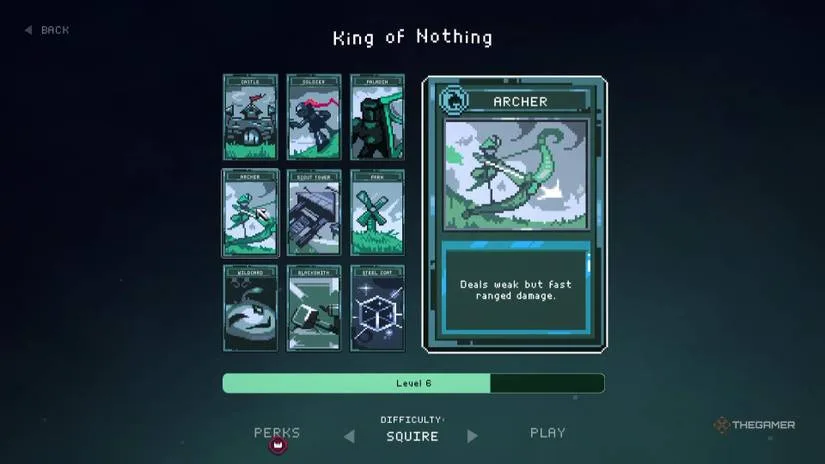
Card illustration for identification; read the current tooltip for updated values.
For a regular campaign, the next dangerous battle and the path to year 33 matter. Prefer a complete smaller engine to a late theoretical ceiling. A troop protecting your existing damage can be more important than a second growth building when the board is close to losing.
For longer play, recurring effects and upgrade interactions become more attractive if the kingdom remains stable. Do not turn historical infinity displays into guaranteed outcomes. Current balancing and technical limits make the observed effect on the battlefield more useful than a dramatic old number.
For multiplayer, inspect the current seasonal decree pool before judging how well a card fits your planned engine. The pool is visible in the lower-left lobby. A card whose appeal depends on an unavailable decree should be evaluated without that dependency.
After choosing a reward, check the result you expected. Identify the receiving plot, the new role and the remaining weakness. If the next fight fails for the same reason, revise the priority. The strongest card is the one that creates useful value in your current kingdom; tiers help identify candidates, while the board determines the final choice.