
An infinite build should mean a build you can keep developing for a long run, rather than a promise of literal limitless survival. Use an engine that continues gaining value, protect its damage source, and keep enough flexibility to repair later enemy matchups. Lab Rat leveling, Mycelium accumulation, and a supported Time growth route are conditional candidates.
Version 0.9.8 is the baseline here. The intended experience is thirty-three years; Patch #30 makes the year ninety-nine ending and result screen clearer, while still allowing you to continue afterward. Old infinite-stat screenshots do not prove a current endless build. Reinforce changed completely, several exploits were fixed, and Hourglass's late progression was rebalanced.
Define what you want the run to sustain
There are several different goals hidden behind the word infinite. You might want to keep playing beyond the ordinary ending, repeatedly develop a kingdom through time travel, or create exceptionally large displayed stats. These are related, but they are not the same result.
A high tooltip number does not establish that the army can survive the next opponent. A rewind loop does not establish that useful damage is growing. A crowded field does not establish that the simulation can handle it comfortably. Choose the goal of continued successful fights first, then evaluate the engine around that goal.
| Growth route | What continues improving | What still needs protection |
|---|---|---|
| Lab Rat leveling | The Rat plot through its leveling relationships | The troop and the support that create useful level events |
| Mycelium investment | Accumulated spores over time | The opening and the army that lets the investment persist |
| Blood summons | Demon Altar through allied deaths | The valuable Demons and enough remaining screening |
| Time development | Useful systems receiving extra development opportunities | The army that must survive those opportunities |
| Gold tower | Dispenser through gold received | Frontline, meaningful hit damage and ordinary income |
The goal is a complete growth relationship. A support building that keeps increasing numbers while its recipient never contributes does not make the run sustainable.
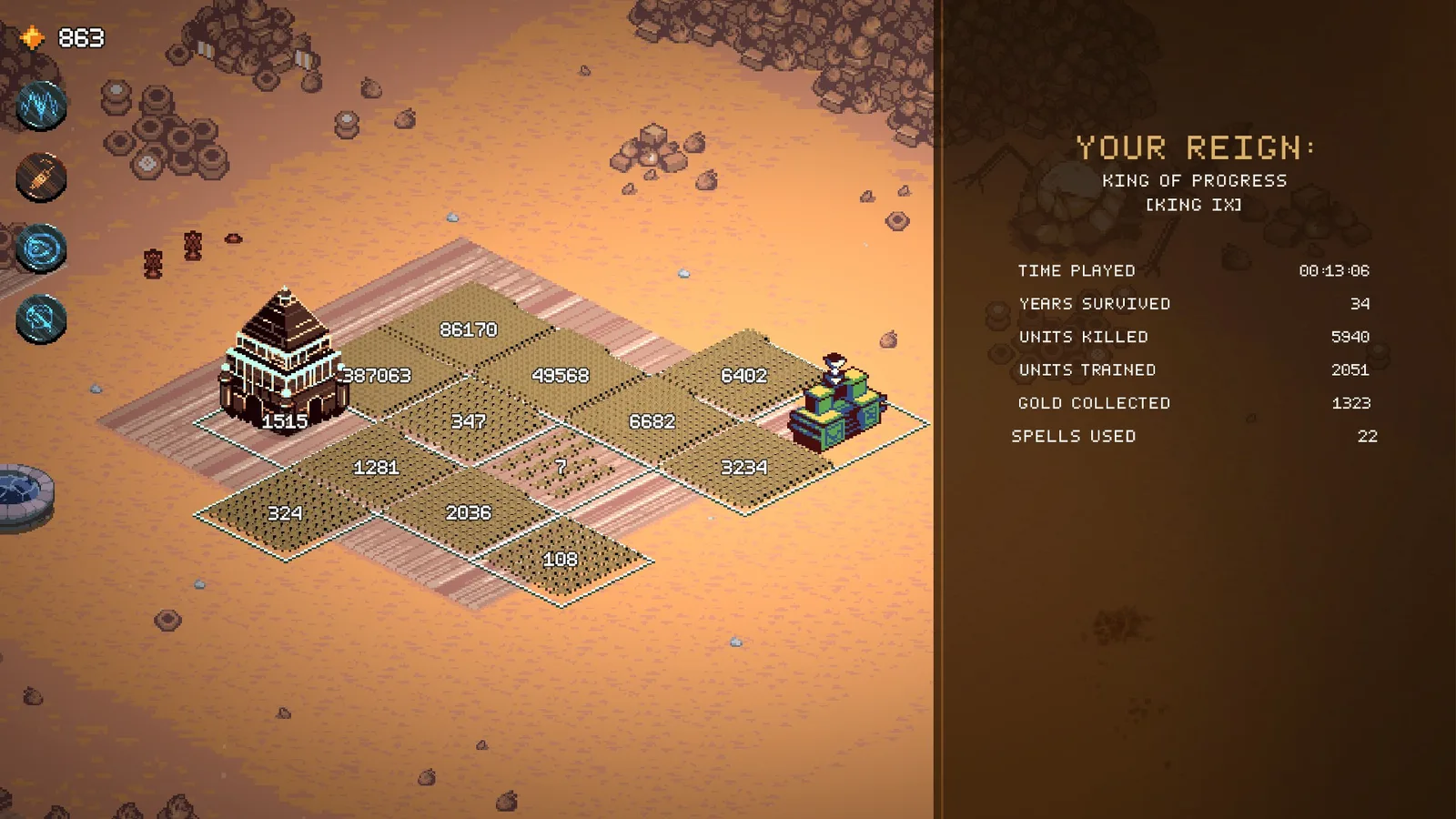
Layout reference only; use current card previews for stats and effects.
Start with an army that reaches its growth phase
A long run begins with an ordinary survival problem. Field a working frontline and a damage source before investing every plot in future scaling. A useful duplicate can preserve the run more effectively than another support card whose recipient is still missing.
Choose an engine early when the army can afford it. Mycelium and Demon Altar benefit from participating over time, while Dispenser wants future gold receipts after it is placed. Delaying every investment can limit growth, but placing all of them without protection can end the run before any develops.
Use the next battle as the first checkpoint. Does the screen survive long enough? Does the attacker finish useful targets? Does the support actually reach the intended plot? Stabilize those relationships before expanding into an elaborate endless setup.
A run need not remain a pure faction army. Off-faction support can improve a weak part of the engine. What matters is whether the additions strengthen the same growth path, rather than consuming space for several competing plans.
Use Lab Rat levels under the current rules
Lab Rats can keep leveling through their adjacency relationships. This offers a continuing development route when your board supplies useful level events. Place them so the intended chain is actually connected, and watch which plots improve when an adjacent tile levels.
The current deck rework matters. Patronage now triggers the Lab Rat chain effect, and Lab Rat's initial stats were improved. Those changes are relevant to a growth plan. However, an old Reinforce damage loop is no longer the same build.
Reinforce now grants health growth each second during battle and can heal beyond maximum health. It no longer increases attack whenever another plot levels. Do not combine the old damage description with the current Rat rules and call the result a verified infinite engine.
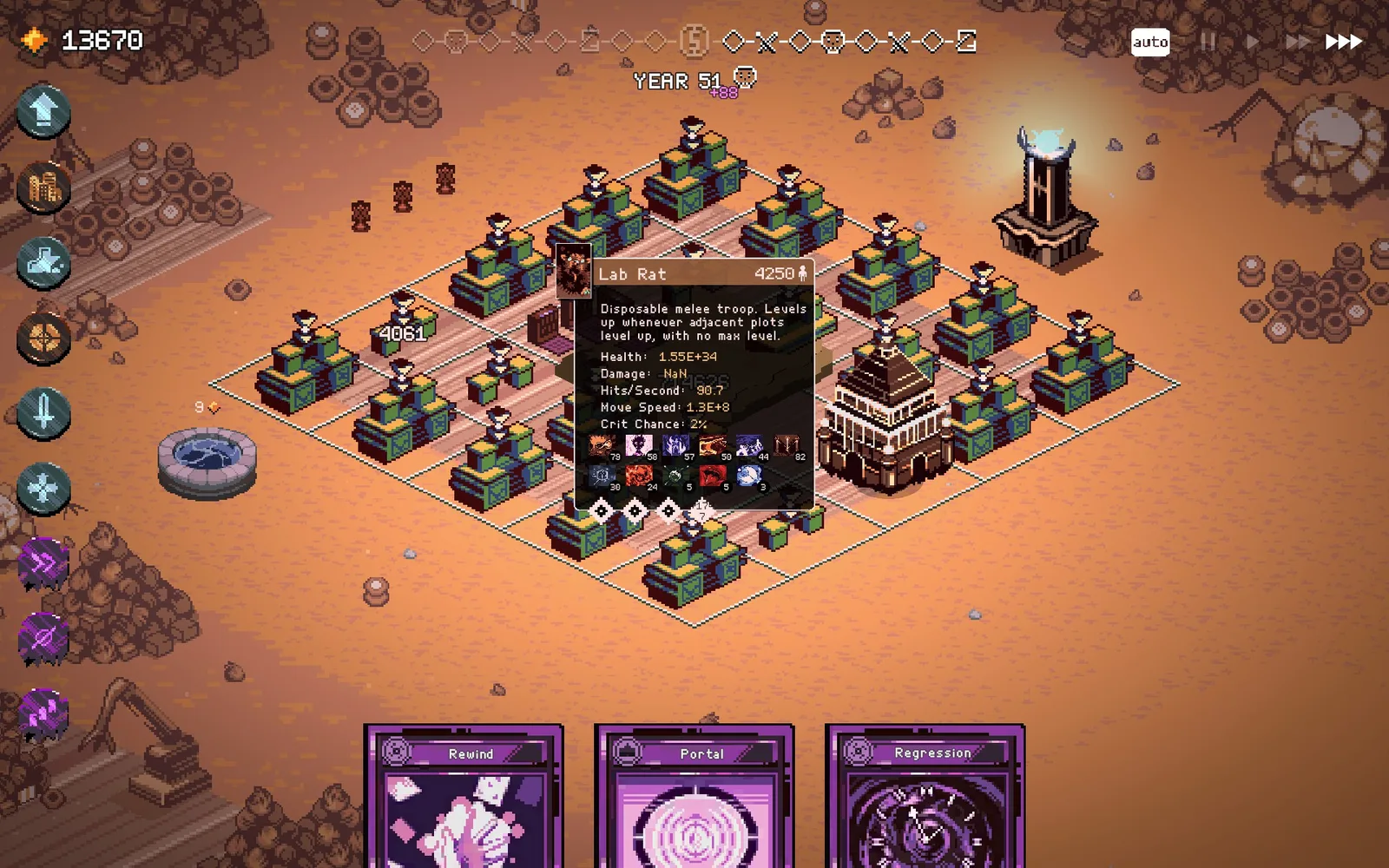
The historical NaN readout illustrates why extreme displayed values do not prove sustainable current combat.
A leveling system still needs damage and protection. If the Rats survive but cannot defeat the enemy, provide a relevant damage route. If they disappear before their combat contribution matters, use protection or another screen. Additional level events do not automatically solve both failures at once.
Treat rare support as a conditional upgrade
Shrine, Temple, Warehouse, and other special support can expand a growth system when drawn. They should be evaluated through their actual current effects and placement rather than a fixed rare-card requirement for every run.
Warehouse adds applications of adjacent support-building effects per level. That creates a direct reason to place it near support already doing useful work. A Warehouse connected to an incomplete or irrelevant support network does not supply the missing army.
Surge activates a target support building repeatedly. Use it on a building whose recipients benefit immediately or whose growth strengthens the present engine. Patch #31 fixed a broken Surge and Library interaction, so a historical infinite demonstration relying on that behavior is not a current recipe.
Rare support also competes for board space. Before adding another multiplier, identify which troop or tower receives the value and how it survives. A smaller system with protected recipients can be more sustainable than a large support field surrounding an exposed attacker.
Keep useful damage separate from displayed scale
A tower or troop can show enormous attack, speed, or health without converting all of it into practical battlefield value. Targeting, attack opportunities, enemy screens, and protective effects influence what actually happens.
Do not plan around an exact hidden speed or numerical cap from old community reports. Those reports conflict and describe different versions or particular runs. The current supplied material does not establish one universal limit for every troop and tower.
Instead, observe whether another speed improvement causes more useful attacks, whether extra damage changes the targets defeated, and whether a health improvement extends survival. If one investment has stopped helping the battle, redirect the next reward toward a different bottleneck.
A large displayed value is also not proof of literal mathematical infinity. It can reflect formatting or a calculation limit. Treat anomalous readouts as a reason to reassess the run, rather than as confirmation that every future enemy is already defeated.
Use portals only with a clear development payoff
Time travel can supply more opportunities to improve a kingdom. It is attractive when the additional development strengthens an engine already in place. Without that engine, repeated portal setup can simply lengthen the same weak army's journey.
Name the payoff before rewinding. More useful levels, more support applications, or more opportunities to develop a protected recipient are concrete goals. Returning to an earlier year because the hand contains a portal is not sufficient by itself.
A repeatable chain also depends on the cards and effects actually available in the current run. Do not promise a closed loop from an old perk page. Check the current card descriptions, hand, and progression behavior before assuming the sequence can be repeated.
Backtracking is limited by a forced encounter: traveling back thirty-three years breaks the time continuum and transfers you to the nearest boss fight. Do not budget an unlimited number of rewinds before making the army boss-ready. Patch #31 repaired a soft lock at this boundary; it did not announce removal of the transfer. In multiplayer, defeating all remaining enemy kings also sends the run toward its final battle. Additional development must therefore fit the available opportunities, rather than assume that portals can postpone completion indefinitely.
Do not make Hourglass's old endpoint the target
Hourglass has produced extreme late-game screenshots in older versions. Patch #31 rebalanced its late-game attack-speed progression, which makes historical timing and performance claims unreliable as a current target.
If you choose an Hourglass route, use a screen and support appropriate to the actual tower. Improve firing opportunities, damage, or protection according to what the battle shows. Do not assume that reaching a number shown in an old image recreates the same results.
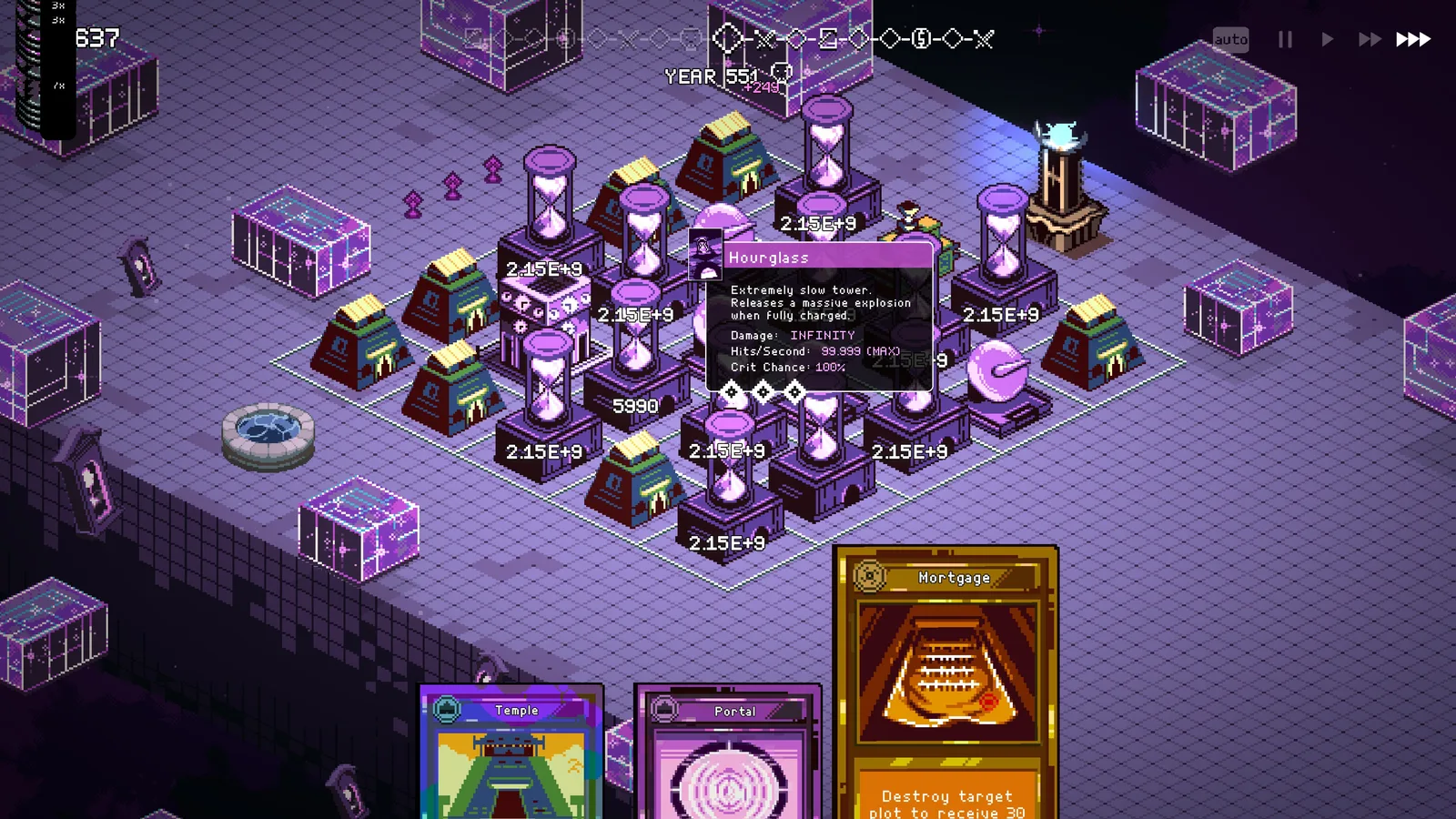
The historical readout is not a verified current endpoint; Hourglass progression changed in Patch #31.
The same rule applies to Dispenser. Gold received supports its speed growth, but weak hit damage or failed protection may still limit contribution. Build income through ordinary current mechanics, then spend or support according to the remaining combat problem.
Patch #30 removed several economic exploits, including unintended loot duplication, full-hand purchase gold, and excessive Vault levels with Overhaul and Speculation. A sustainable present build should function without those behaviors.
Maintain a screen through later fights
As damage grows, it becomes tempting to remove defensive plots and add more multipliers. That can expose a valuable attacker to a matchup the army previously handled through screening. Retain enough protection for the enemy patterns you actually encounter.
A screen can be a troop army, summons, walls, or control tools suited to the damage route. Trapper traps now stun, and their damage increased in Patch #31. Wallmaker has yearly health growth under the deck rework. These are relevant options when your engine needs time to attack.
Do not rely on health alone for every late enemy. Protective effects can change how individual incoming hits work, while positioning and targeting can determine whether the carry is reached at all. Use a defense appropriate to the failure instead of multiplying the same stat indefinitely.
If the main attacker dies before acting, a damage multiplier elsewhere is unlikely to repair the first failure. If the screen lasts but enemies remain alive, another defensive investment may simply delay the loss. Distinguish those situations each time the difficulty changes.
Reassess enemies as the run develops
Diplomacy changes both reward access and the enemies you face. An opponent that supplies a useful early card can become a dangerous later matchup. Keep its reward access when you still need a meaningful tool, then reassess once that tool is secured.
Do not call one enemy permanently safe or permanently impossible based on an old endless run. Patch #31 nerfed enemy Ballistas and Demons in singleplayer and quest mode. Those changes affect historical comparisons without establishing a guarantee for your army.
Preserve a way to handle different targets. A build that clears many small enemies may still struggle against a durable target. A very powerful single-target attacker can struggle to clear a large screen. Complement the main damage pattern when the current army leaves a recognizable gap.
Continue beyond the ending with practical expectations
Year ninety-nine now leads to a clear final result screen, and you can choose to continue. There is no new progression novelty promised after that point, and the intended standard experience remains thirty-three years. Continuing is therefore a personal challenge rather than a necessary part of completing every run.
High troop counts and long chains can also make battles less comfortable even though recent patches improved performance. Keep the kingdom readable and avoid multiplying plots that contribute little simply to inflate population.
A sound endless plan remains observable: growth improves a useful attacker, protection lets it contribute, and rewards repair new bottlenecks. Continue while those relationships work. Treat literal infinity, guaranteed numerical endpoints, and current world-record claims as unproven rather than as required outcomes.