
A practical gold build connects income to combat: get a Dispenser into play early, earn gold through Vault and other available effects, and retain enough savings to support Mercenary troops when they form your frontline. Spend when a purchase solves an immediate weakness; preserve gold when spending would shrink the army you need for the next fight.
This guide follows version 0.9.8. Vault now levels automatically each year, and the Mercenary baseline is nine gold per unit after the deck rework. Old full-hand shopping gold exploits and excessive Vault-level loops were fixed. The plan below uses ordinary card effects rather than relying on an infinite money exploit.
Distinguish income from money held
Dispenser and Mercenary care about different parts of your economy. Dispenser gains attack speed through gold received. Mercenary population depends on your gold reserve. A coin earned and then spent can still have contributed to Dispenser growth while no longer supporting a hired troop.
That difference explains why a gold build needs two checks. First, does your income engine grow the tower often enough to matter? Second, does your spending leave a sufficient frontline? A high income total does not guarantee a large army at the beginning of the next battle.
| Card | Economic role | Combat implication |
|---|---|---|
| Vault | Supplies yearly gold and automatically levels each year | Supports a longer term income plan |
| Dispenser | Improves attack speed through gold received | Wants income after it is placed |
| Mercenary | Uses held gold for troop count | Can lose numbers after spending |
| Midas Touch | Offers gold through troop kills | Needs a recipient that secures kills |
| Mortgage | Converts a destroyed plot into gold | Removes the plot's existing contribution |
| Over-invest | Spends gold on target stats | Competes with shops, rerolls and troop reserves |
| Palace | Adds a gold route through its attack effect | Provides Greed's base contribution |
Do not count the same economic improvement twice. A larger wallet may help Mercenary and offer purchases, but the money cannot remain in reserve and fund a purchase simultaneously. Read the army after spending, rather than assuming its previous unit count still applies.
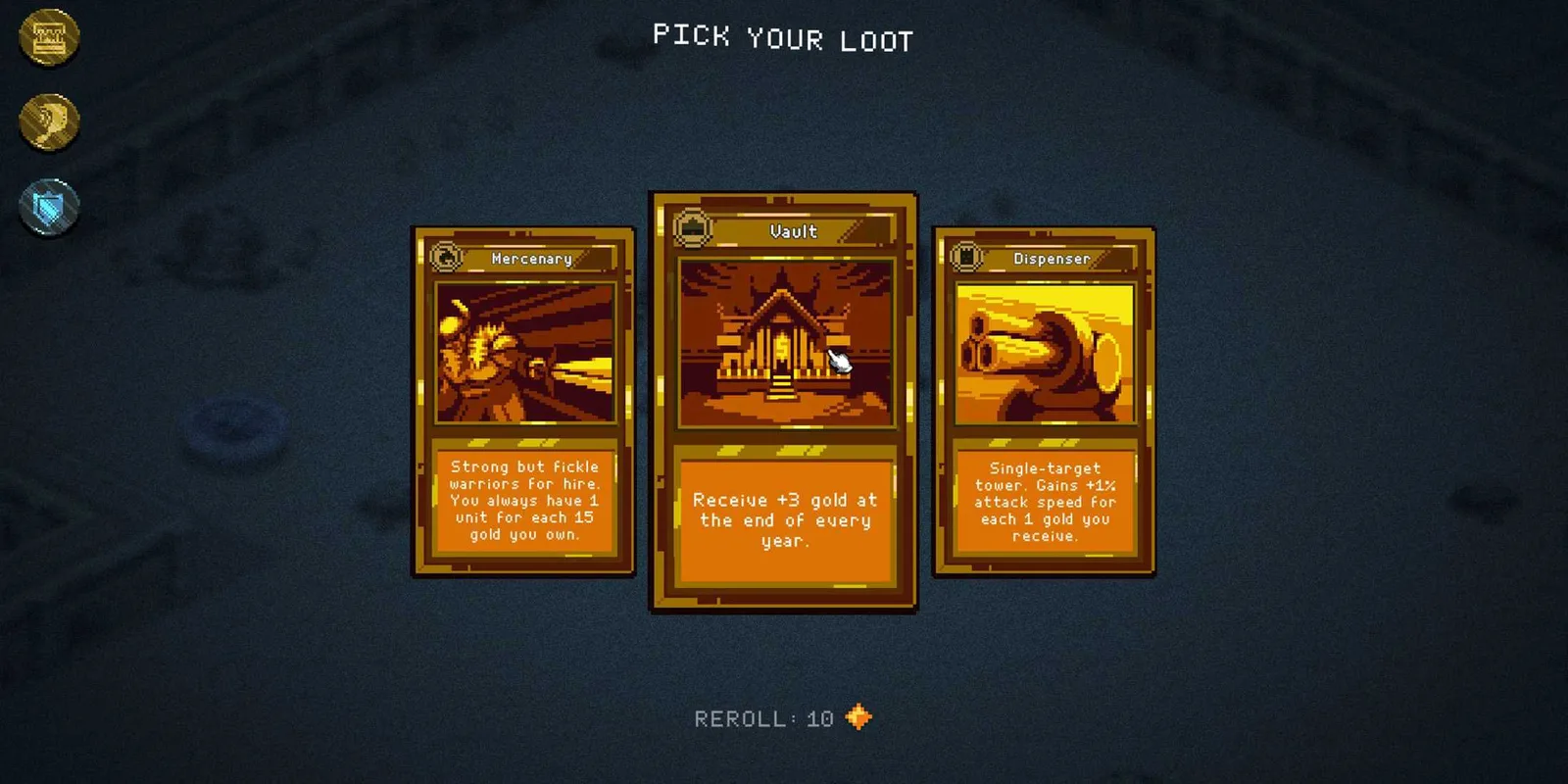
The pictured Mercenary cost is historical; its current baseline is nine gold per unit.
Establish combat before maximizing income
The opening priority is to keep a useful army on the field. A Dispenser is attractive early because future gold receipts can improve it, but it still needs enemies occupied long enough to attack. If your hand offers troops before a tower, use them to establish that screen.
Vault is an investment that uses board space. Placing several Vaults can be sensible when the present army already wins its fights, but it is risky when those plots would otherwise hold your only damage or frontline. Income that arrives after the run ends has no practical value.
Choose a small economic core first. One functioning tower and a dependable frontline are easier to support than multiple weak towers and a field of income buildings. Expand when the first system is stable and a new plot improves its growth without opening a defensive gap.
A useful opening reward can therefore be a combat duplicate instead of another money card. Improving the troop that holds the enemy may give your existing Dispenser more opportunities than adding income while leaving that troop weak.
Place Dispenser before the income you want it to use
Dispenser benefits from gold received while it is present. This makes placement timing part of the build. Do not assume a tower drawn late will automatically possess all the value of money you earned much earlier in the run.
Once a Dispenser is working, improve both its opportunities and the value of its hits. Attack speed is one component. Blacksmith can support neighboring damage, while Quarry offers a tower damage route. An army that fires quickly but does too little per hit may need those improvements more than another speed investment.
Observe the battle rather than treating a displayed attacks-per-second figure as a promised result. Targeting, enemies remaining alive, and how long your screen lasts determine what the tower actually contributes. Old discussions of extreme speed values do not establish a current simulation limit or guaranteed damage output.
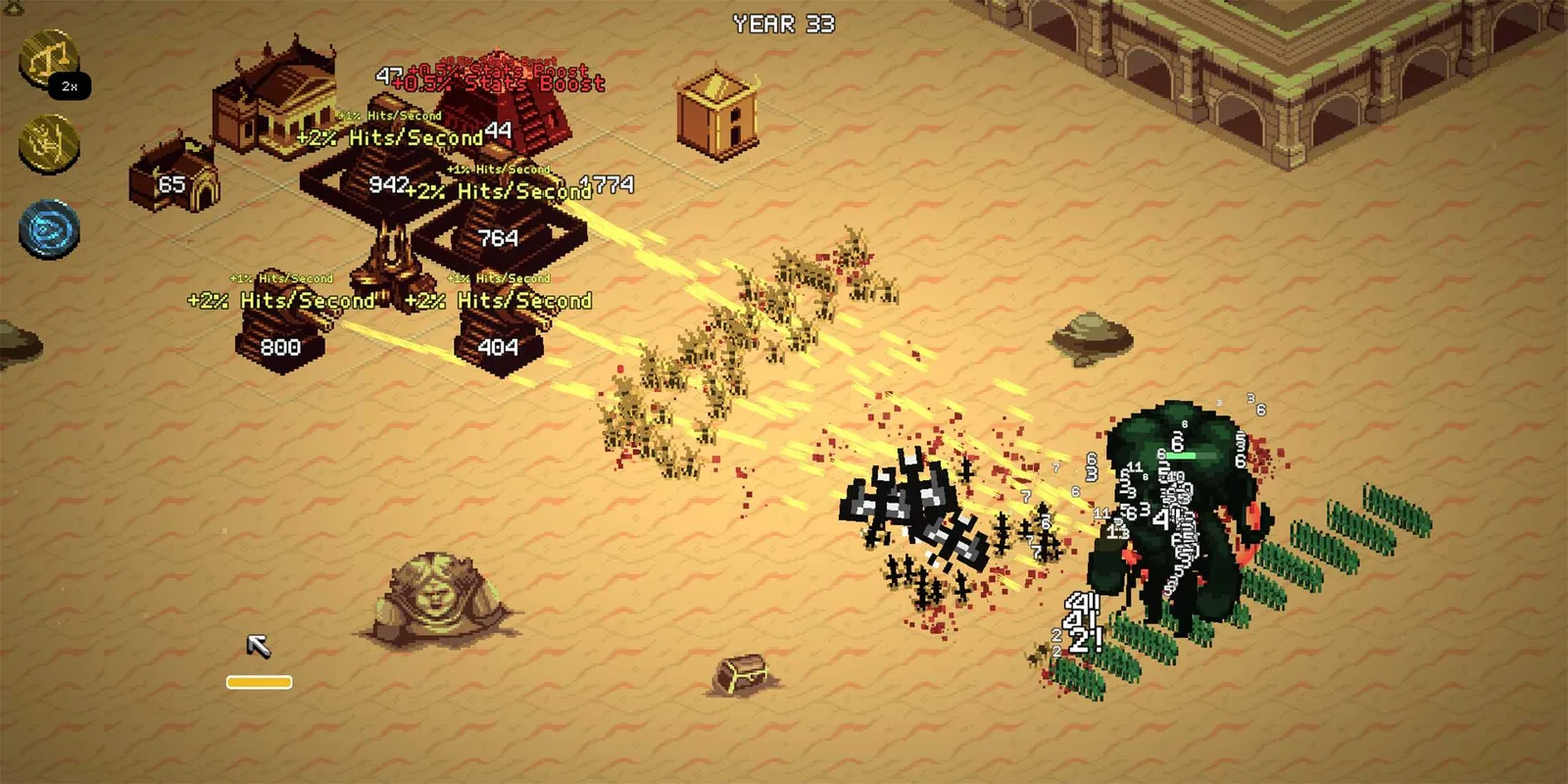
Layout reference only; use current card previews for stats and effects.
If enemies reach the tower before it contributes, repair the frontline. If they remain occupied but do not die, consider damage support or an appropriate complementary attacker. A second Dispenser can be useful, but it does not automatically fix a shared lack of protection or low hit damage.
Grow Vault without relying on an obsolete loop
Vault now levels automatically every year. That gives an early Vault a natural growth path. The Speculation decree can raise its level cap, but whether that is available and worthwhile depends on the run and mode.
Overwork now works with Vault. When considering that pairing, inspect the current description and affected plot so that your expected extra activation matches the version you are playing. Do not reproduce an old diagram whose results came from an unintended leveling interaction.
Patch #30 specifically fixed a glitch involving Vault, Overhaul, and Speculation that allowed more leveling than intended. That means old gold totals or claims of limitless shopping from such a loop are not a sound plan for current play.
You can still use Vault as ordinary income. The sensible question is whether another Vault or a Vault upgrade is better than a combat improvement you could take instead. A stable army can afford more investment; an unstable one needs enough immediate power to reach the following income event.
Protect your Mercenary reserve
Mercenary gives a gold build a natural troop option, but its strength depends on the wallet you carry into battle. Before buying several cards or rerolling repeatedly, inspect whether your hired troops will retain enough numbers to screen the tower.
The current baseline of nine gold per Mercenary unit replaces older advice using fifteen. Perks and other modifiers can affect what you see, so use the current troop preview for your actual army. A fixed savings target copied from another build may not fit your level, support, or opponent.
Gold reserve is not a reason to refuse every purchase. Buying a key damage upgrade may improve the army more than the troops you lose by spending. Conversely, buying a distant support piece that cannot yet connect may be a poor exchange for a working frontline.
Make that comparison concrete. If you spend, what improves before the next fight? If you save, what does the additional troop population accomplish? A gold build should buy combat value, not simply maximize a number in the interface.
Use Mortgage on a plot you can afford to remove
Mortgage destroys its target and pays gold according to the target's levels. This can monetize an obsolete troop, an unwanted building, or a temporary plot whose useful job is complete. The gain is attractive only if the board remains functional after destruction.
Hover the target and assess everything that plot currently supplies. It may connect a support pattern, hold enemy attention, or provide your only answer to a certain target. Those contributions can be worth more than the immediate payment.
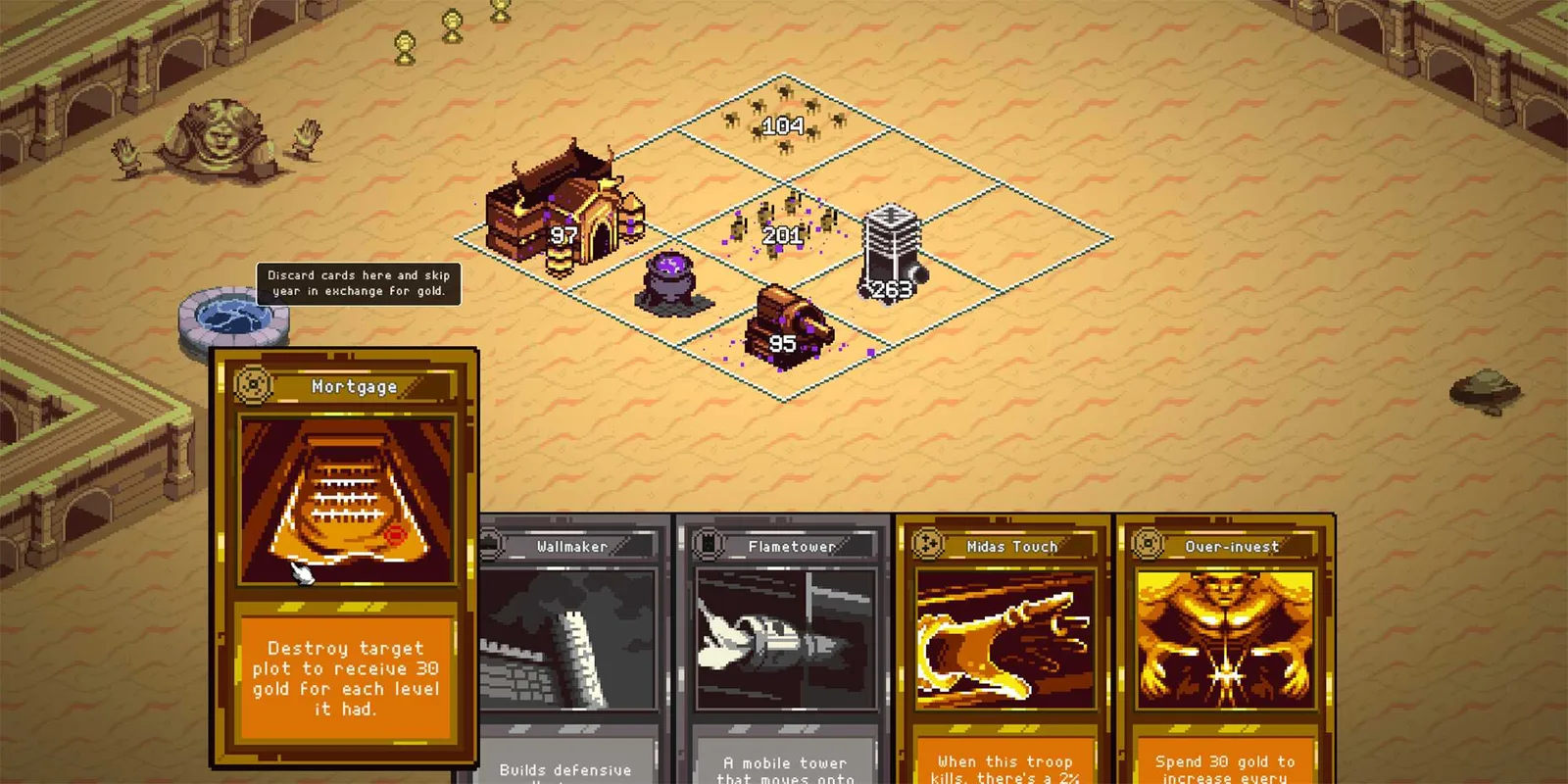
Check the contribution of a plot before destroying it for gold.
Do not place and destroy arbitrary plots purely to imitate a high gold screenshot. The sequence costs cards, actions, and space. Use it when the payment supports a clear improvement and the sacrificed plot is truly expendable.
Mortgage also differs from returning cards or using another destruction effect. If your goal is to rebuild the same plot elsewhere or preserve its card value, check what the available tool actually returns. Gold and cards are different resources; the appropriate choice depends on what you need next.
Match Midas Touch to a troop that gets kills
Midas Touch creates a gold opportunity when its recipient kills enemies. A large squad is not automatically a good recipient if it rarely secures kills. Put the effect where your army's damage pattern makes it useful.
A troop that reaches many vulnerable enemies can be attractive. A screen that only absorbs damage may not exploit the enchantment as well. If your frontline gets stronger later and begins finishing enemies, the best recipient can change during the run.
Avoid an exact expected gold calculation when the kills are uncertain. Enemy health, your other damage sources, and targeting all influence which troop finishes each target. Use the effect as supplementary income, rather than promising it will fund a fixed number of rerolls every year.
You also should not weaken a working build just to create more gold triggers. A troop must still contribute to winning fights. Income earned through useful damage is easier to maintain than an income plan that depends on leaving dangerous enemies alive.
Evaluate death income as a complete system
Some decrees and special cards provide money through deaths. Insurance is a relevant example when available, and Scapegoat provides a specific death-based gold route. These fit armies that already produce expendable units more naturally than armies built to preserve one scarce carry.
The useful combination is deaths, income, and a remaining combat plan. If your fodder dies while a Dispenser benefits from the receipts and another troop still occupies enemies, the system has a clear purpose. If everything dies and no attacker remains, earning money has not repaired the battlefield.
Availability matters especially in multiplayer. Patch #31 rotates the seasonal decree pool. Check the lobby's current pool before making a death-income decree essential to your plan. Have an alternative route using Vault or ordinary combat improvements when the expected option is absent.
Budget purchases and rerolls around the next fight
Define an acceptable purchase before spending. A tower damage improvement, a frontline duplicate, or a support card with a ready recipient is easier to assess than an open-ended search for the perfect final deck.
Keep a fallback when the desired reward does not appear. Another effective troop can stabilize the opening. A relevant off-faction damage source can carry the army while the economic engine develops. Refusing every alternative can leave you with money and no working battle plan.
Over-invest belongs in this same budget. It can amplify a suitable target, but its gold cost competes with preserving Mercenary numbers and finding more important pieces. Use the preview and your next opponent to judge whether that stat gain is the purchase the army needs now.
A healthy economy creates options. If the run is already stable, reinvest in growth. If it is about to lose, use the wallet to repair the problem before the fight. The best gold build is the one whose income, reserve, and purchases all support a surviving army.