Build damage by supporting a carry that can actually stay in combat. A troop plan can develop damage with Blacksmith and attack cadence with Beacon; a tower plan can use Quarry alongside a suitable attacker and defensive time. Start with a functioning attacker, then invest in the factor currently limiting its output.
This guide uses version 0.9.8, Patch #31. It does not promise infinite damage, a fixed ending year or a tested current-meta build. Reinforce is now a health effect during battle, and Hourglass late-game attack-speed progression has been rebalanced. Those facts rule out copying older damage recipes unchanged.
Identify the damage bottleneck
A large attack statistic does not mean the kingdom deals useful damage. An attacker may fire slowly, die before it attacks, or spend its attacks on enemies that are not the immediate threat. Start by watching what happens before the base is reached.
| What the battle shows | Priority to examine | Why more raw attack may not solve it |
|---|---|---|
| The carry dies quickly | Protection and survival | It loses the opportunity to deal damage |
| The carry survives but attacks too slowly | Attack speed and combat time | Large hits may leave too many enemies alive |
| Many weak enemies remain | Area damage or more effective coverage | A single-target attacker may be doing the wrong job |
| One durable enemy holds the line | Damage on a useful target | Scattered weak attacks may not remove the blocker |
| Support fills plots without results | Recipients and placement | The effect may miss the relevant damage source |
| A promising engine arrives too late | Opening strength and growth timing | Future output cannot recover an already lost fight |
Use that observation to choose the next upgrade. If you cannot identify a bottleneck, keep the kingdom simple enough to inspect. Concentrating support on one clear carry makes it easier to see whether a change in damage, speed or survival altered the next fight.
A practical Blacksmith damage core
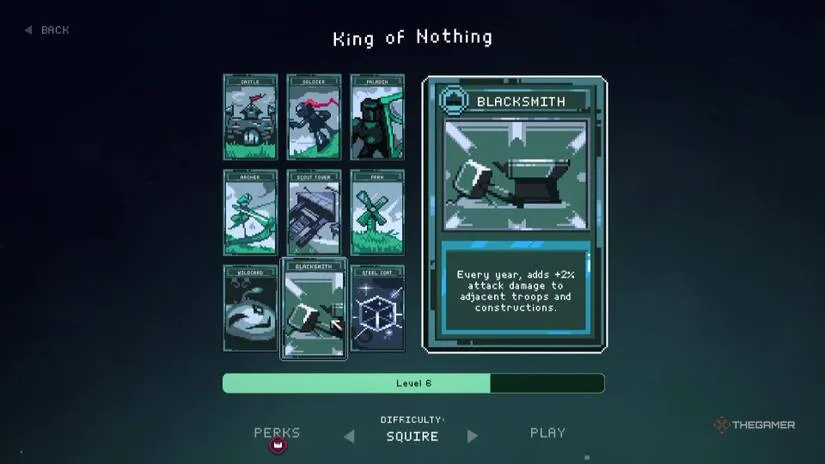
Card illustration for identification; read the current tooltip for updated values.
Nothing supplies a clear starting route because it has ordinary attackers and Blacksmith in the same deck. Choose a troop or Scout Tower that already contributes in combat, then put Blacksmith where its recurring effect reaches that recipient. The support relationship is the core; filling every remaining plot is optional.
A Blacksmith placed early has more years in which to improve a useful attacker. That is a planning advantage, not a reason to place support before any fighting force exists. If the current board cannot survive, compare the support investment against a direct troop or tower upgrade that makes the next battle viable.
Keep a defensive job beside the damage job. A melee troop can hold enemies away while a ranged unit or tower works. Population support may also buy more time, but judge it by the recipient and the fight. A Farm supporting a plot that contributes little to protection or damage is not automatically a better damage investment than upgrading the carry.
If Beacon becomes available from Greed's tools, it can address attack speed for adjacent troops and towers. Put it next to the actual damage source instead of giving it an isolated plot. The combined idea is straightforward: develop the strength of useful attacks, increase the opportunity to perform them, and preserve enough defense for both improvements to matter.
A tower route with Quarry
Quarry improves tower damage across the kingdom. That makes it useful in a plan that already has damaging constructions, especially when space limits how many local support relationships you can maintain. It is a poor reason to abandon a functioning troop army before any useful towers exist.
Scout Tower offers a recognizable damage recipient, and its projectile count scales with plot level in the current design. Stone's Trebuchet provides an area-damage option that benefits from constructions. Choose between them according to what your board and card access actually support; this is not a promise that a particular tower is always the strongest.
Towers still need time. Wallmaker or another appropriate defensive layer can prevent enemies from reaching the base too quickly. An additional damage support building may be the wrong play if the carry is already lethal but cannot complete enough attacks before the defense collapses.
Quarry's broad effect also does not justify placing several unsupported towers of every type. Concentrate upgrades where you see useful contribution. A second tower is worthwhile when it adds coverage or another productive recipient; otherwise it can dilute the cards and space available to the established carry.
Current Stone changes matter. Trebuchet gained area damage in the deck rework, Trapper traps now stun, and Patch #31 increased Trapper damage. Use the current descriptions to decide whether control or area damage fills the missing job. Enemy Ballista nerfs apply to singleplayer and Quest opponents, not automatically to the damage value of your own card.
Troop damage needs a durable recipient
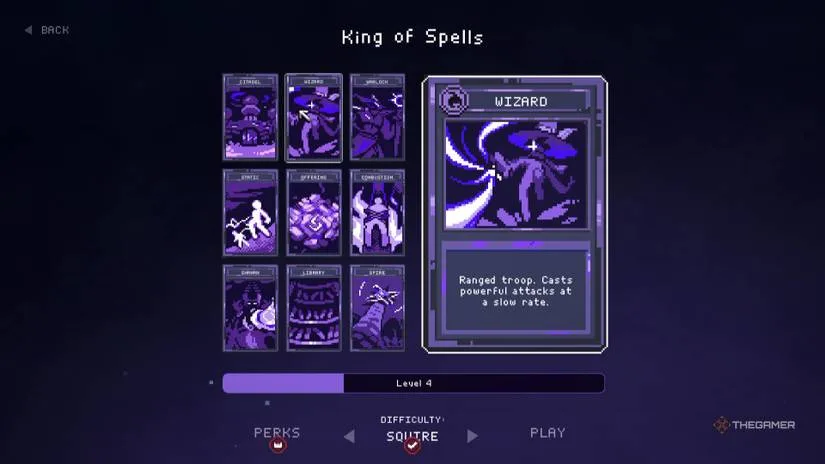
Card illustration for identification; read the current tooltip for updated values.
Wizards are a slow-firing ranged damage option; Archers offer a faster attack pattern. Those different roles create different support needs. A Wizard plan may want more attack cadence and protection, while an Archer plan may make better use of effects applied through repeated hits.
Do not read that distinction as a universal tier order. The available upgrades, enchantments and opponents matter. A supported ordinary attacker can be more useful than a supposedly superior unit placed too late with none of the relationships your kingdom developed.
Steel Coat is a survival tool rather than a direct damage statistic. Its value to a damage plan comes from preventing damage instances that would remove the recipient. Health support and a durable frontline serve the same broader objective through different mechanics: keep the damage source active long enough to act.
Shaman deserves separate treatment. It contributes through support to other troops rather than functioning as an ordinary attacker. Investing in its attack can therefore have an indirect purpose, but only when you have a troop force that benefits. A kingdom with a strong Shaman and no effective recipients has not solved its damage problem.
For every troop addition, identify whether it is the carry, protection or support. That role assignment makes reward choices clearer and prevents a board where several cards require investment but none becomes strong enough to carry the fight.
Enchantments change the kind of damage
An enchantment can give an existing attacker a new damage pattern. Static spreads damage through chained effects, while Combustion relates area damage to kills. These effects need a recipient that can hit useful targets and, for a kill-triggered effect, actually finish enemies.
That dependency is easy to overlook. Applying a kill-triggered enchantment to a weak attacker does not create a strong crowd-clear plan by itself. First make the recipient effective enough to activate the effect, then consider multiplying its enchantments with legitimate support such as Library.
Poison is another distinct route. Current Poison Vial applies more stacks than the launch-era one-stack descriptions, and Cauldron was changed to provide poison stacks by level. A poison plan should account for the time enemies remain exposed, not only the number of attacks shown on a tooltip.
Do not mix every damage effect into one recipient without a purpose. If a Library is part of the plan, you want its development to benefit the effects that make that troop useful. Extra unrelated effects can make it harder to evaluate what the carry needs next.
Patch #31 fixed a broken Surge and Library interaction. Legitimate enchantment growth is still a possible strategy, but an obsolete exploit cannot be the engine that this guide promises. Read the current tooltip and observe the receiving troop after the support action rather than trusting an old extreme-number screenshot.
Advanced damage growth through upgrades and recycling
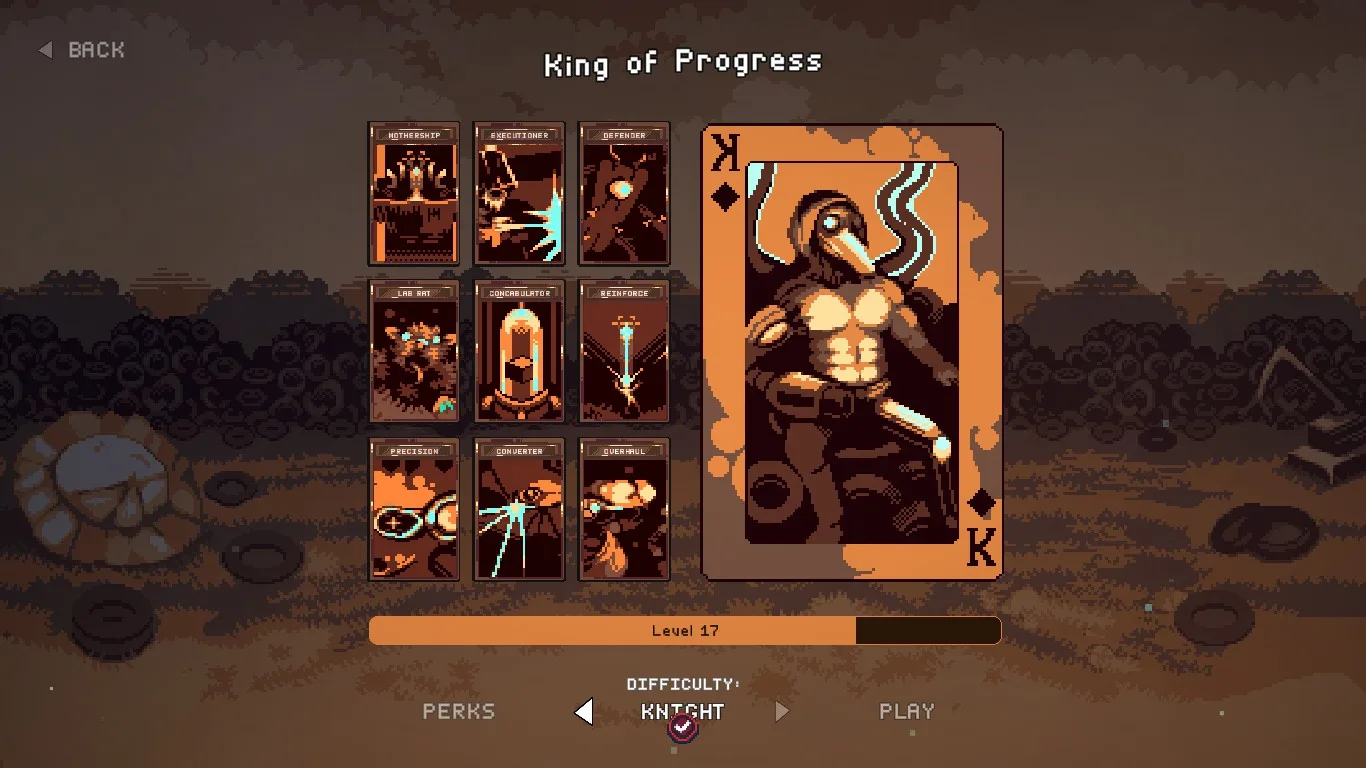
Ruler identification screen; this older illustration may show a previous deck arrangement. Read current tooltips for card effects.
Progress offers a different route: a kingdom that gets more value from deliberate upgrades. Lab Rats can level beyond ordinary limits and respond to neighboring upgrades. This gives a reason to place them beside plots you can realistically develop, rather than isolate them and hope the level increases automatically.
Recycler connects cards thrown into the pit with damage and health growth for adjacent plots. The planning task is to supply useful recipients and a discard flow without consuming cards the kingdom still needs. The effect is not permission to throw away every card; a missing defensive upgrade can cost more than the resulting growth contributes.
Reinforce now supplies health during combat and can heal above maximum HP. It may help survival in a current build, but it is not the old upgrade-triggered damage multiplier. Any sequence asking you to apply Reinforce and then farm plot upgrades solely for attack is outdated.
A progression engine should still pass the ordinary damage test: can it defeat the next enemy before the base falls? An elaborate future ceiling does not guarantee that its opening survives. Treat advanced upgrade interactions as a way to improve a working force, or deliberately accept that the run is an experiment whose dependencies may not arrive.
Decree choices follow the existing engine
A decree should amplify the damage pattern your kingdom already uses. Overwork can add useful support activations when the board contains productive support buildings. A tower-speed effect can matter in a tower plan, while a poison effect belongs in a kingdom already applying poison reliably.
Critical-chance and critical-damage effects also require context. Improving critical damage is more valuable when useful attacks can actually crit. Increasing attack cadence or solving survival may be a better immediate choice when the current attacker rarely contributes at all.
Compare the next fight as well as the future engine. A broad immediate improvement may keep the kingdom alive long enough for repeated support to develop. Conversely, a recurring support improvement can be attractive when survival is already stable and several important recipients benefit each year.
In multiplayer, confirm that the desired decree appears in the season's pool before planning around it. Patch #31 rotates the pool, and it can be inspected in the lower-left lobby. This is a practical access requirement, not an optional detail of a damage recipe.
Avoid misleading infinite-damage targets
Historical players have described very large numbers, infinity displays and crashes in extreme runs. Those reports do not supply a reliable current damage cap, guarantee that the display matches effective damage, or establish a repeatable route for your present version.
Hourglass is especially sensitive to this distinction because its late-game attack-speed progression changed in Patch #31. An older discussion saying that a particular support becomes unnecessary at a claimed cap is not a verified instruction for the current card. Examine what the current tooltip and battle show before replacing a useful support plot.
For ordinary play, measure the relevant outcome: the kingdom clears the wave with protection remaining. For longer-term experiments, track which growth mechanism still creates a useful change. Do not sacrifice a reliable board simply to produce an extreme displayed number that no longer changes the result.
The current intended ordinary experience is a 33-year campaign, with year 99 identified as the true ending. No experience is gained after year 99. Damage beyond that target can be an experiment, but it is not required to validate a successful damage build.
Improve one limiting factor at a time
Before your next play, name the carry and the failure. If the carry cannot survive, strengthen protection. If it survives without clearing enemies, examine damage, speed and coverage. If support misses it, fix the placement. If the entire plan depends on an unavailable import, use a supported attacker you already have.
After the fight, check whether the change addressed the predicted problem. Repeat that process as the kingdom develops. A damage build succeeds because useful attacks occur often enough, on relevant targets, while the base remains safe. That is a better guide to the next card than chasing the largest number on any single tooltip.