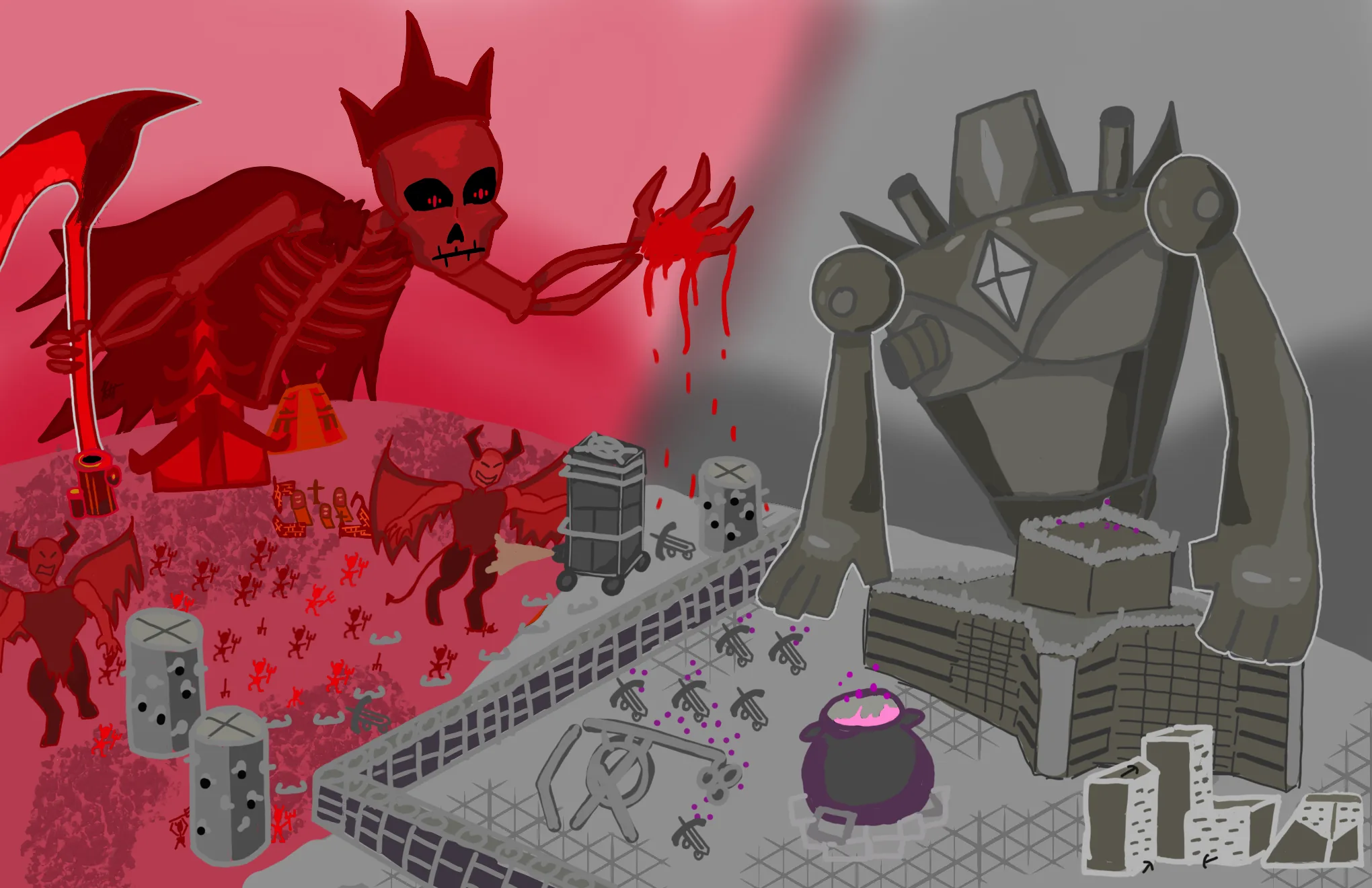
Useful 9 Kings card combinations connect a reliable trigger to a useful payoff. Farm grows nearby troop counts, Library develops enchantments on eligible adjacent troops, and Recycler turns discarded cards into buffs for neighboring plots. A combination works when you can obtain its pieces, place the right recipients, and survive long enough for its effect to matter.
This guide explains several practical relationships for version 0.9.8, Patch #31. The examples are conditional strategy suggestions rather than a tested ranking or guaranteed multiplayer recipe. Your starting king, rival decks, and seasonal pool determine which pieces you can actually use.
Build the trigger and recipient first
Read each combination as three parts: the action or event that triggers it, the card that responds, and the plot that receives the benefit. This prevents a common mistake in which you collect several individually promising cards without creating the relationship that makes them useful.
A support building next to an ineligible target contributes less than its position suggests. A destruction engine needs something you can remove without losing the kingdom's main combat force. An enchantment engine needs a recipient with enchantments already applied. The visible card names alone do not establish those conditions.
Prioritize a small working pair before building a larger network. Once the pair functions, another support or multiplier can improve it. If you reserve every available plot for a final diagram before creating any immediate combat strength, the kingdom may never reach the point where that diagram becomes useful.
The game helps you inspect the relationship. Upgrade previews show which values increase, and Patch #31 highlights plots affected by Amplifiers. Support-building effects also have clearer visual feedback. Use the display to confirm the recipient before committing a valuable card.
Farm with a developed troop
Farm increases the unit count of eligible adjacent troop plots over time. A troop that already supplies a useful battlefield role can therefore gain more bodies while retaining the investments you make in its plot.
Soldier is a straightforward recipient to understand, while Paladin can supply a more defensive role. The important combination is the troop's role plus the Farm's continuing population growth. Do not decide solely from the initial count printed on the troop card.
Place the Farm so its cardinal adjacency reaches the troop you intend to grow. If it reaches more than one useful recipient, the same support plot can contribute to several roles. However, spreading all upgrades across several weak troops may leave no developed plot capable of surviving the next fight.
Blacksmith adds a different layer by increasing nearby eligible damage. This lets you distinguish the two needs: Farm supplies population, while Blacksmith supplies damage growth. Add the layer that addresses the current weakness rather than assuming every troop requires every support at once.
Before using a destructive Tome near this arrangement, check its target. Removing the main troop to generate another resource can erase the result of earlier preparation. Use a disposable or secondary plot when the effect allows a choice and the kingdom still needs its established frontline.
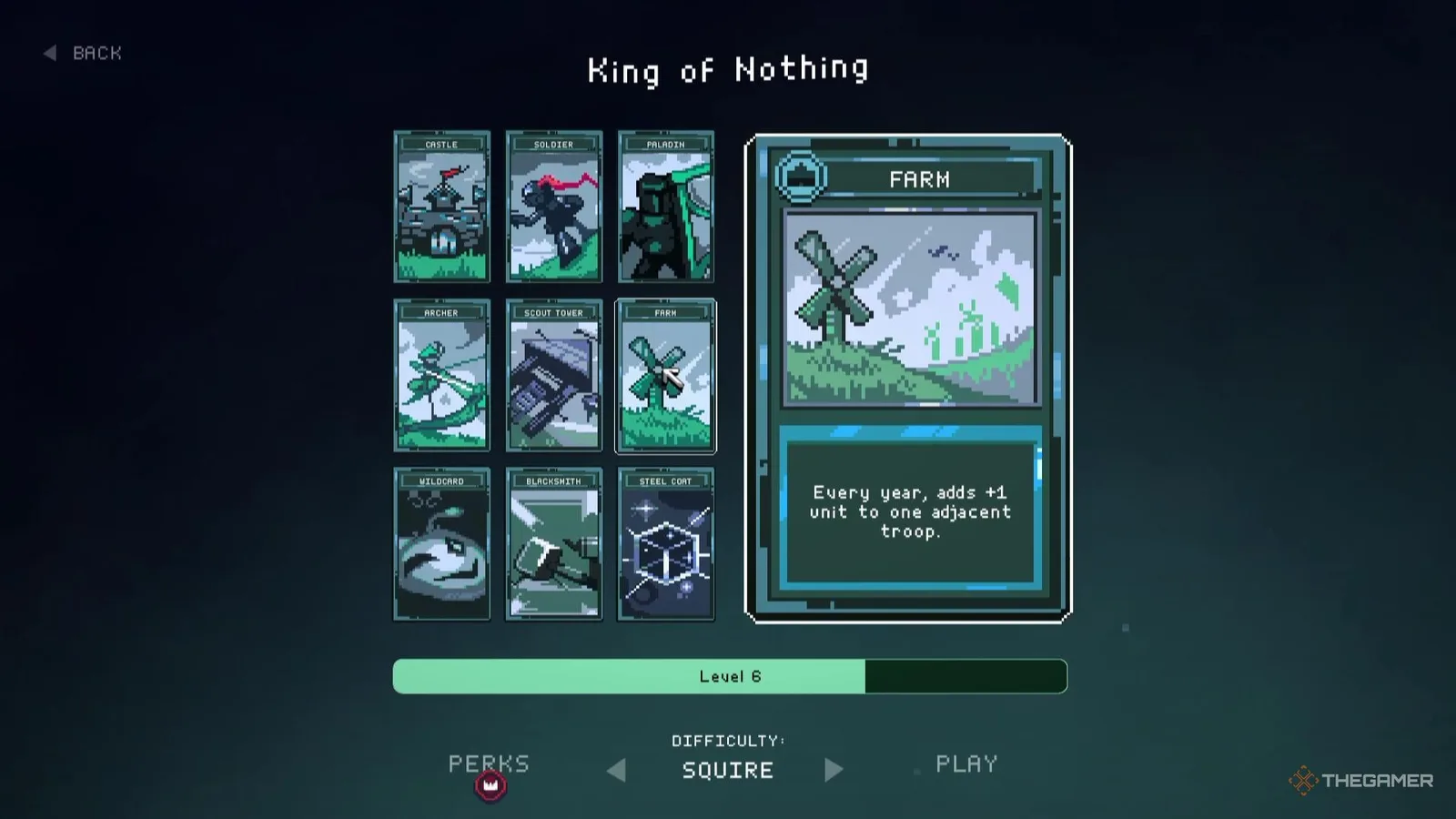
Historical interface illustration; use the current in-game description for effect values.
Library with a focused enchantment recipient
Library develops enchantments on eligible adjacent troops. Its value therefore depends on having a useful troop, an enchantment you want to grow, and enough time for the building to contribute. A Library without a relevant enchanted recipient is a support piece waiting for its actual engine.
Steel Coat offers a defensive relationship: the enchantment negates incoming damage instances, while Library provides a route to increasing enchantment stacks. A Wizard or another vulnerable damage source may benefit from more time to attack, but the protection still needs to match the number and timing of enemy hits.
An offensive enchantment can instead turn attack opportunities into additional effects. Static is associated with damage chains, while Combustion adds a payoff when a unit kills an enemy. Read the trigger carefully: a kill effect needs kills, so increasing its stacks on a unit that never finishes enemies may not solve the problem.
Avoid applying every available enchantment merely to make the list longer. When your plan depends on a particular effect growing, unrelated additions can make the engine less focused. First identify the defensive or offensive problem you are solving, then choose enchantments that contribute to that role.
Patch #31 fixes a broken Surge and Library interaction. Treat an older demonstration built around that broken interaction cautiously; it cannot establish a current unlimited outcome. Library remains an enchantment-related support, but its current behavior must govern the combination.
Forest with Boar and a useful rider
Forest increases nearby troop HP. Boar interacts with an adjacent rider, allowing the health investment in the Boar to matter beyond the Boar's own durability. This makes positioning a part of the combination rather than an optional finishing detail.
Start by deciding which troop should contribute as the rider. A ranged damage source and a defensive troop serve different battlefield needs. The appealing rider is the one whose role your kingdom can use, not simply the newest card you drafted.
Then place the Boar and the rider so their adjacency is correct, and reserve a Forest position that reaches the intended health recipient. Check the resulting relationship before filling another neighboring plot. A grid crowded with extra troops can make the arrangement harder to complete.
Do not copy an old rider-stat formula without checking the current effect text. The relationship between Boar health and rider strength is useful to understand, but the exact scaling depends on the current card and any modifiers in the run. The practical check is whether the intended rider receives the displayed benefit.
A stronger mounted unit still needs time to act. If the enemy removes it immediately or another battlefield role is missing, adding more health to the same arrangement may not address the full failure. Use the next fight to identify whether the limiting factor is durability, damage, targeting, or coverage.
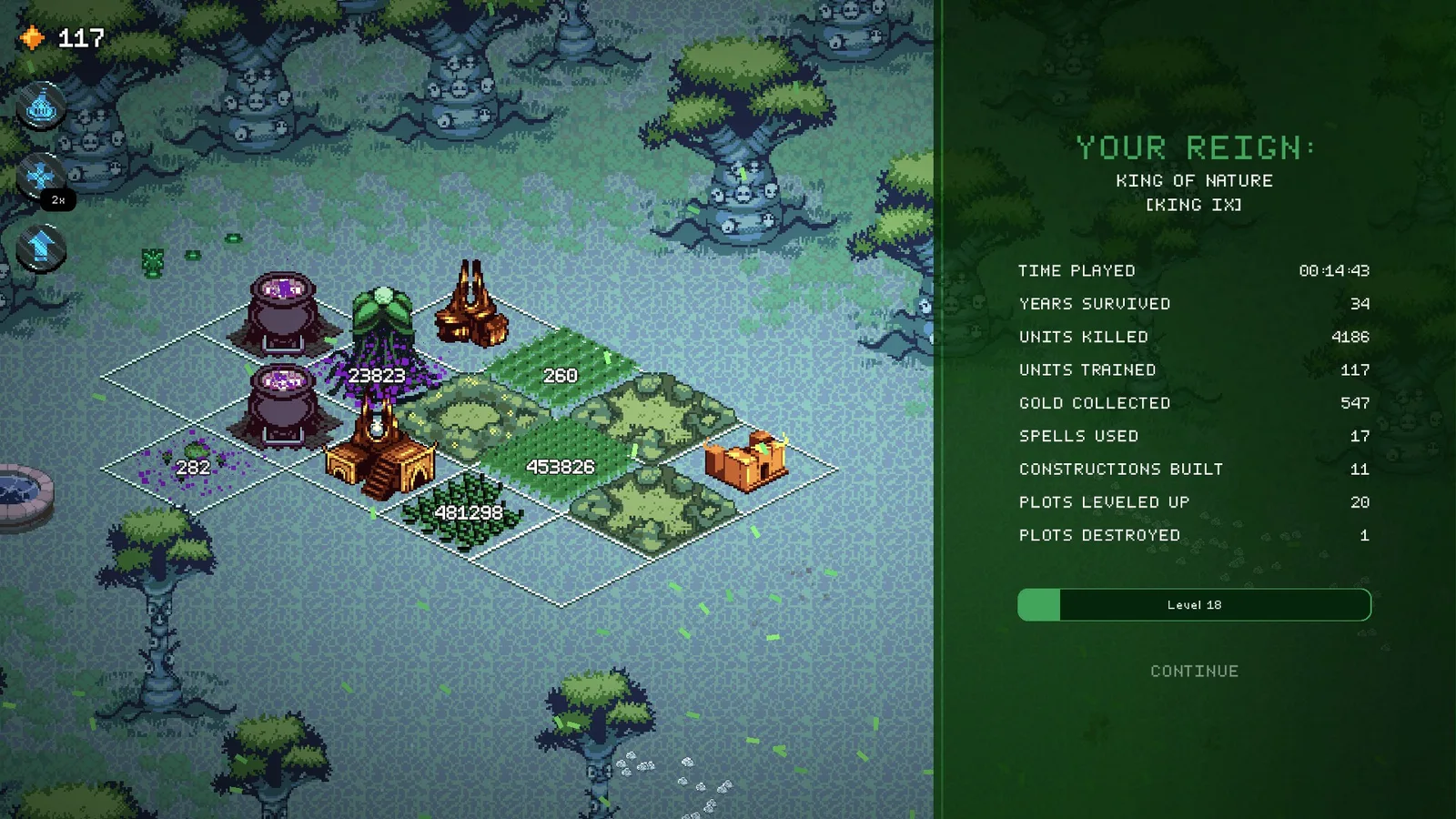
Historical Nature layout illustrating neighboring troop and support plots. Displayed counts are not build requirements.
Recycler with pit cards and Oblation
Recycler rewards throwing cards into the pit by improving adjacent plots. Patch #29 introduced it to the Progress deck in place of the old Precision slot. Its trigger is discarding a card, so the building needs eligible nearby recipients before you spend a valuable card for the buff.
Oblation adds a second reason to use the pit. It replaces Vampirism in the Blood deck and increases troop population when thrown into the pit. Its effect develops through other cards being discarded. Together, the cards can turn selected discards into both local buffs and a population-related payoff.
Set up the board in the correct order. Place the useful recipients, put Recycler where it can reach them, and then use the discard actions that serve the plan. Throwing away a key card before placing the Recycler does not create the same relationship afterward.
The cost is still real. A card sent to the pit cannot also be used for the upgrade or placement it would otherwise provide. Discard cards with a clear reason: an unusable option, a spare piece the kingdom does not need, or a card whose pit effect is the intended benefit.
Trashy can add another branch when Recycler is destroyed, but it is a perk interaction rather than a requirement for the basic card pair. Establish the ordinary Recycler and pit relationship first. Then consider whether a planned destruction has enough value to justify removing the support building.
Cemetery with adjacent destruction
Cemetery converts eligible deaths into Skeleton-related value. Its current behavior also responds when an adjacent troop plot is destroyed, creating a Skeleton plot in that position. This lets you evaluate a destructive action by both its own reward and what the neighboring Cemetery adds.
Blighted provides a related starting point by adding a Pile of Bones card when a Cemetery is placed. Placing a Pile of Bones next to a Cemetery creates a Skeleton troop inheriting Cemetery statistics, with the current Patch #30 rule specifying nine units per Cemetery level.
Read the recipient positions before placing the Bones. The useful action depends on adjacency to the Cemetery, not merely on having both cards somewhere in the kingdom. If another plot blocks the desired location, adjust the plan before using the card.
Mangler supplies another death-centered relationship. It destroys units as part of its growth and summons meat trolls, and Patch #31 adds HP growth from destroying units. Demon Altar also benefits from allied deaths. These cards can share a theme, but they still require distinct positions and triggers.
Avoid the older descriptions that say Cemetery and Pagoda simply produce Imps. Cemetery summons Skeletons, Pagoda summons Ghosts, and Mangler produces meat trolls in this version baseline. Those differences matter when a perk or decree names a particular summon or card.
Leveling chains with Lab Rats
Lab Rat is associated with growth when adjacent plots level. A connected arrangement therefore benefits from actions that generate upgrades around it. The important planning detail is which plot levels and how the neighboring relationships carry that event.
Overhaul destroys a target and distributes upgrades elsewhere in the kingdom, providing a route to repeated development. Before using it, identify the disposable target and the plots you hope to improve. If the target is your developed main troop, the loss may outweigh the upgrades.
A leveling chain needs combat support during assembly. The early form of the arrangement may not withstand the same enemies as its later version. Keep a functioning attacker or defensive layer rather than assuming the future chain compensates immediately for every missing role.
Reinforce no longer provides damage whenever another plot levels. Patch #29 reworked it into battle-time HP growth and healing beyond maximum HP. This invalidates old explanations that combine Rat leveling with Reinforce as an automatic damage-scaling loop.
You can still assess Reinforce as a durability effect, but that is a different job. Read the current enchantment and decide whether the recipient stays in battle long enough to use it. A renamed strategy with the old premise is not a current combination.
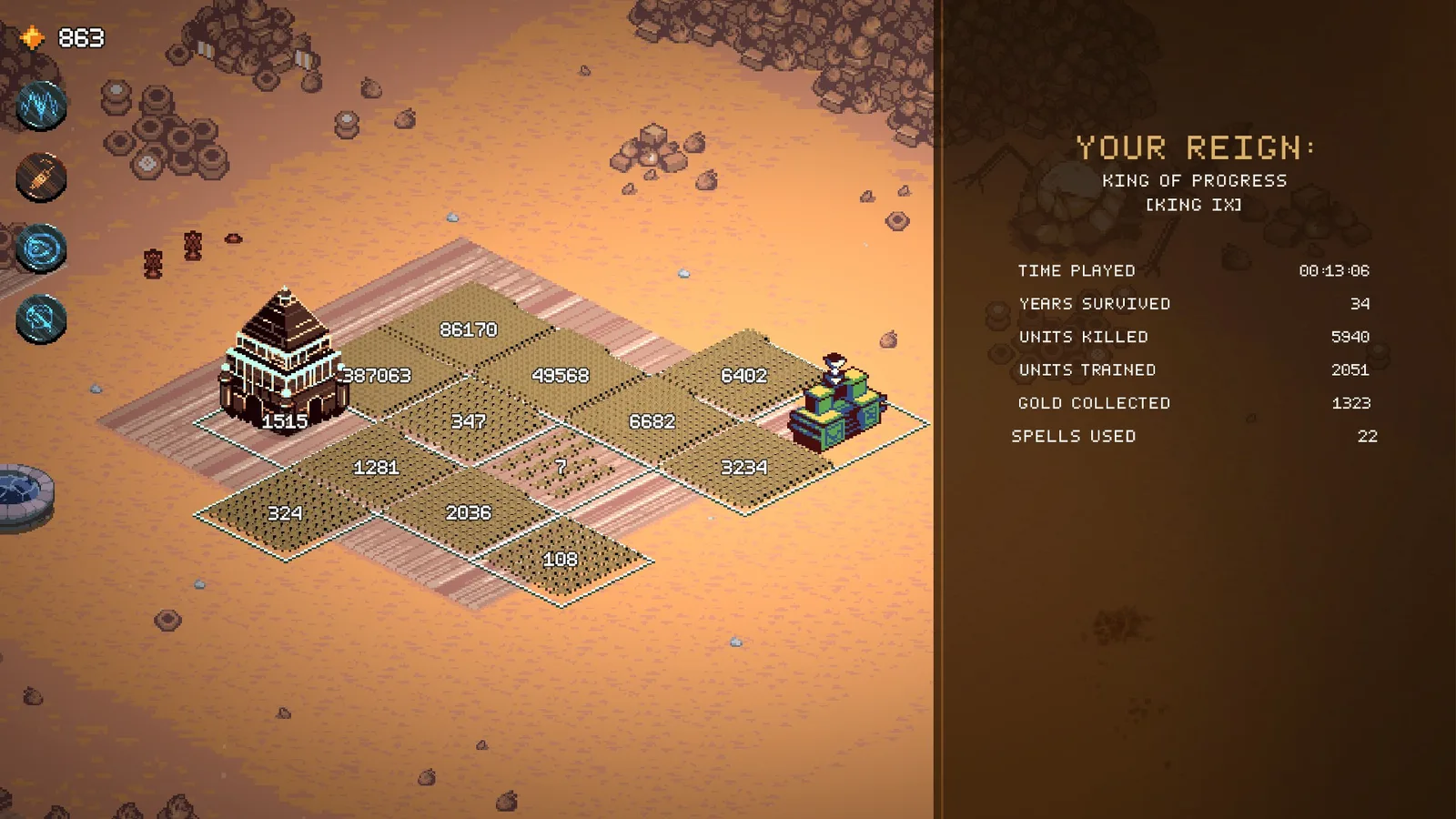
Historical Progress layout illustrating a connected group of developed plots; displayed results do not establish current performance.
Economy with Vault and gold-sensitive cards
Vault now levels automatically each year. It provides an economy piece that can develop while the kingdom fights, and Speculation raises its level cap. A gold-sensitive combat card can then turn the growing economy into battlefield value.
Mercenary troop count depends on gold, with the revised ordinary cost set at nine gold per unit. Dispenser grows through gold earned. These are different measurements: gold currently held and gold gained over the run should not be treated as interchangeable.
Before buying or rerolling, identify which gold relationship the kingdom needs. Spending can find a necessary card, but it can also affect a troop whose count depends on the wallet. A stronger long-term economy does not excuse an immediate defense gap.
Patch #30 removed an unintended Vault-leveling exploit involving Overhaul and Speculation. Use the supported card effects rather than reproducing that old exploit. Likewise, extra loot and full-hand gold glitches are not valid foundations for a current competitive plan.
For any of these combinations, keep the next action concrete: obtain the missing card, confirm eligible adjacency, preserve the combat core, and inspect the result. Add a third or fourth layer only when it improves the relationship your kingdom is already using.