
9 Kings perks are upgrades you equip before a run to change its opening and strengthen particular cards or mechanics. Regular perks provide effects such as starting resources, troop bonuses, or card-specific improvements. Rainbow perks alter how the perk layout applies those effects. Your active loadout, rather than the full list of unlocked perks, determines what the next run receives.
Perks have changed substantially during Early Access. This guide explains the system and confirmed reworks for version 0.9.8, Patch #31. It does not reproduce an old complete perk list or rank every option: first establish what an effect currently does and whether your chosen king can use it.
Unlock perks through king progression
Playing runs develops your king's progression and unlocks perks. The perk collection includes universal options that can be used across kings and king-specific options tied to a particular deck or theme. The unlock screen and the game's displayed progression are the practical place to inspect what is available on your account.
Do not assume every player receives the same named perk at the same point. Community descriptions report varying unlock orders, and older guides describe earlier versions of the progression system. A route that depends on one specific perk being your next reward is therefore less dependable than reading your actual unlock progress.
Rainbow perks add another progression track associated with the highest developed king and milestone unlocks. Older lists show only a subset of today's options, so the absence of a perk from an old table does not mean you cannot encounter it. Check the current perk collection instead of treating a historical count as the live total.
Choose a progression target that also teaches a useful deck. Repeatedly playing a king gives you practice with its cards, but unlocked perks should have a practical purpose. If a new perk supports a card you rarely use, it may be an option for another loadout rather than an automatic addition to every run.
The game provides no additional EXP beyond year 99. Patch #30 makes that boundary clearer in the result flow. Continuing afterward can serve an extended survival experiment, but it is not an unlimited route to more perk progression.
Distinguish regular perks from layout effects
Universal perks describe effects with broad applicability. A starting life, a general troop damage increase, or a summon bonus can be useful to more than one king. However, broad availability does not mean that every kingdom benefits equally: a troop effect contributes little to a plan that primarily relies on towers.
King perks are more closely linked to a king's cards or mechanics. Hunter relates to Trapper, Arcane relates to Wizard, and Blighted relates to Cemetery. Start by naming the affected card. If that card is absent from the plan, multiplying the perk does not supply the missing card or create the intended engine on its own.
Rainbow perks work on the perk screen itself. Leftist affects the perk to its left, Verticalist affects vertically adjacent perks, and Nationalist targets adjacent king perks. Expander provides more layout space. Their value depends on both position and eligible recipients.
Read those directions literally. A perk in a visually nearby slot is not necessarily the target described by the effect. A diagonal neighbor, a universal perk beside a king-only multiplier, or an empty slot can leave the arrangement doing less than you intended.
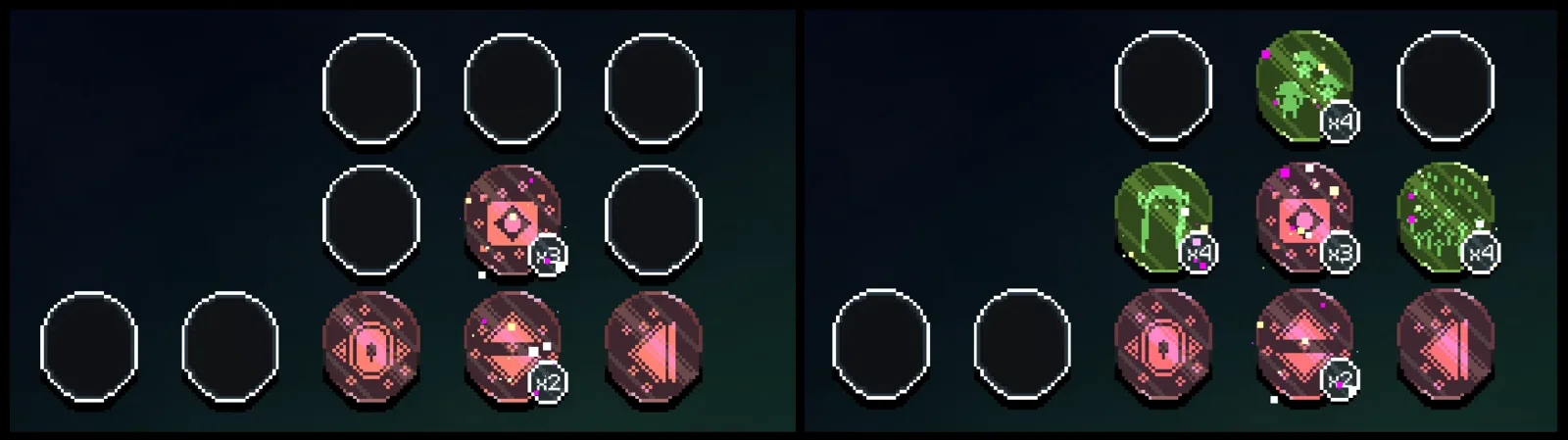
Illustrative perk arrangement. Read the current perk screen for effective applications and eligibility.
Inspect the active loadout before starting
The game supports three saved perk loadouts for each king. Use them for distinct purposes: a reliable opening, a specific card engine, or an alternative that addresses a recurring weakness. A saved loadout should make it easier to review your intended behavior, not simply preserve a crowded layout.
Before launching a run, check the selected king, the selected loadout, and the affected cards. Then read the effective values in the perk screen. This is particularly important after moving a rainbow perk, because the same regular perk can receive a different number of applications in another position.
A simple review sequence is:
- Identify the card or mechanic that should carry the opening.
- Confirm that its related perks are equipped rather than merely unlocked.
- Check the directional targets of each rainbow perk.
- Read the effective starting cards, resources, and bonuses.
- Confirm that the rest of the kingdom has a way to survive while the engine develops.
When you change a loadout, keep the purpose visible in your own planning. Replacing a defensive starting effect with a delayed growth effect changes more than the final theoretical power. It can change whether the kingdom reaches the point where that power matters.
Current universal and multiplayer changes
Patch #30 introduced or revised several broad effects. Thorough gives one random card from your king in year 33. Resilient provides an additional starting life. Elevated makes all summons ten percent stronger at the start. Wrathful increases starting troop damage by ten percent.
These effects operate at different times and on different targets. Resilient provides additional room for mistakes or a difficult opening. Thorough is a later card reward. Elevated needs a summon to improve. Wrathful applies to troops. The appropriate choice depends on the actual kingdom, not on assuming all four are interchangeable general upgrades.
Vigilant provides two more years of multiplayer protection. Use the displayed protection period when planning the opening, particularly if you are comparing your run with an example that used another loadout. More protected years do not automatically build a combat engine for you.
Moderate fixes universal perks at two applications. Authoritarian fixes the top-left regular perk at three applications. The patch explicitly defines those values as fixed. Do not count another nearby multiplier and assume that these effects rise above the stated value without checking the effective result.
Blood and Progress perks support new triggers
Blighted now adds a Pile of Bones card when you place a Cemetery. This changes it from an ordinary summon-stat idea into a placement-triggered card reward. Plan a useful Cemetery position and a suitable location for the Bones rather than expecting a passive bonus to appear on every summon automatically.
Explosive gives Bombers three additional starting units. Diabolical adds nine Ghosts to Pagoda's summon capacity. Those effects strengthen different parts of the Blood deck. A Bomber opening and a Ghost-centered plan may share a king but still need different support and battlefield roles.
Butcher was reworked with the Blood deck to give Mangler extra damage per sacrificed unit. Mangler itself now gains HP when destroying units in Patch #31. These related effects help explain why a death engine should be evaluated through its trigger and recipient instead of through the card's old starting statistics.
Trashy replaces the former Bellicist perk in Progress. It adds a Trash card whenever Recycler is destroyed. Recycler is now the deck's pit-related support building, so destroying it becomes a specific event with a perk reward. That does not remove the cost of losing the building and its future support effects.
Older descriptions that grant Reinforce as a starting damage-scaling tool also need care. Reinforce's current behavior is battle-time HP growth and healing beyond maximum HP. Do not build a loadout around the former upgrade-triggered damage effect.
Spells and Nature perks need eligible cards
Arcane now gives Wizards one percent more damage for each enchantment the Wizard bears. The card-specific relationship is the important part: enchantments on another troop do not become Wizard enchantments, and the perk does not replace the need to obtain and apply useful enchantments.
Sorcerous gives Warlocks one percent more HP for every Tome used. This supports a different card and statistic from Arcane. A kingdom choosing between those effects should begin with which unit it expects to develop, rather than treating both as generic Spells damage increases.
Eldritch gives Shamans twenty percent more damage, while Electric adds three damage to Static. A Shaman's support role and a Static-related damage effect have different recipients and triggers. Read how the relevant card contributes before allocating a multiplier to it.
Nature's Toxic makes poison ticks ten percent faster. It is not the older description of ten percent more poison damage. The distinction matters when explaining why a poison effect develops during combat. Gardener supplies its Orchard increase per plot level, rather than as a flat effect unrelated to development.
Elven gives Elves twenty percent more damage. These specific effects can complement a Nature plan, but they do not prove that any one is always preferable. A kingdom without poison cannot use a poison-tick improvement in the same way as a developed poison recipient.

Historical interface illustration; use the current in-game description for effect values.
Stone, Nomads, and Time reworks
Hunter now lengthens Trapper stuns by fifty percent. Traps stun enemies after the Patch #30 rework, so the perk contributes a control effect rather than the older straightforward Trapper damage bonus. Patch #31 also increases Trapper damage, but those are separate changes.
Rebellious adds one unit to Mob plots each year. Reptilian gives Dragon Den a three percent buff per destruction effect. Jurassic increases Raptor damage by twenty percent. These affect annual growth, destruction-triggered growth, and starting damage respectively; a Nomads loadout should choose the mechanism its actual cards can use.
Brutal now gives all your troops an initial Adrenaline stack. It no longer applies only to the first troop you place. Patch #31 also corrects Orbiter's handling of adjacent troops placed with pre-applied enchantments, with Brutal given as the example. That interaction makes placement order and eligible adjacency relevant to the perk's value.
Exiler allows Bastion to warp troops one additional time. Destructive now supplies forty percent per stack in Patch #31, superseding the fifty percent value introduced in Patch #30. Use the newest applicable effect when comparing loadouts.
Patch #31 fixes the freezing interaction between King of Time, Wise, and Amplifiers. Begin a fresh run after updating so that the corrected run data applies before drawing conclusions about whether the combination still freezes troops.
Choose perks by the problem they solve
If the opening repeatedly collapses, inspect starting cards, starting resources, and immediate combat bonuses. A future reward will not necessarily solve an early failure. If the opening is stable but the kingdom loses momentum later, inspect the perk associated with the growth engine you already use.
If the loadout contains a strong multiplier but no eligible recipient, change the arrangement before adding another effect. A smaller bonus applied to the correct card is more useful than a larger apparent multiplier pointing at an empty or unsuitable slot.
Finally, compare runs with enough context. Record the selected king, perk loadout, relevant seasonal options, and the kingdom's role. A win does not reveal which perk caused it, and a loss does not prove that a perk is useless. Use the current effective descriptions to make one purposeful change, then inspect how the next kingdom develops.
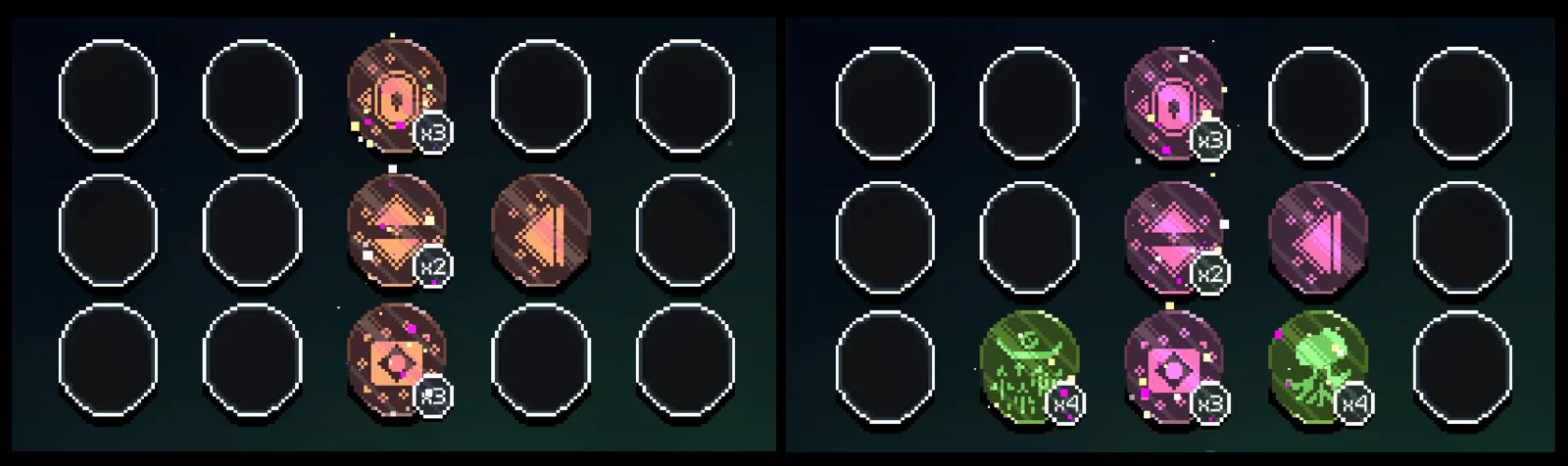
Illustrative perk arrangement. Read the current perk screen for effective applications and eligibility.