
For a current 9 Kings card database, start with the in-game Compendium: Patch #31 adds card statistics to that screen, and Patch #30 lets it show Rainbow and Chaos cards you have used. This page is a selected written reference to card roles and recent changes. It is not a searchable interactive database or a complete export of every current card and statistic.
Use the tables to identify a card's broad function, then inspect the live description when exact values, eligibility, or a developed plot's statistics matter. The reference uses version 0.9.8 as its baseline and excludes old numerical claims that conflict with current reworks.
Read the Compendium and plot for different tasks
The Compendium helps you identify cards and compare their displayed information outside the pressure of a turn. The current version shows statistics, making it more useful when a card's name alone does not explain its combat role.
Your placed plot is a different object. It can have upgrades, support gains, enchantments, and run-specific modifiers. A developed troop's current HP or damage should therefore be read from its plot and current effects rather than inferred only from a base card reference.
Rainbow and Chaos Compendium entries are tied to cards you have used. If you have not encountered an entry yet, an incomplete collection does not prove the card is unavailable everywhere in the game. In multiplayer, consult the season's pool to determine which rainbow options are available for that run.
When checking a card, record its type, trigger, recipients, and timing. Type tells you which perks and effects can apply. The trigger explains what must happen. Recipients define eligibility. Timing distinguishes an immediate reward from growth that requires future turns or battle time.
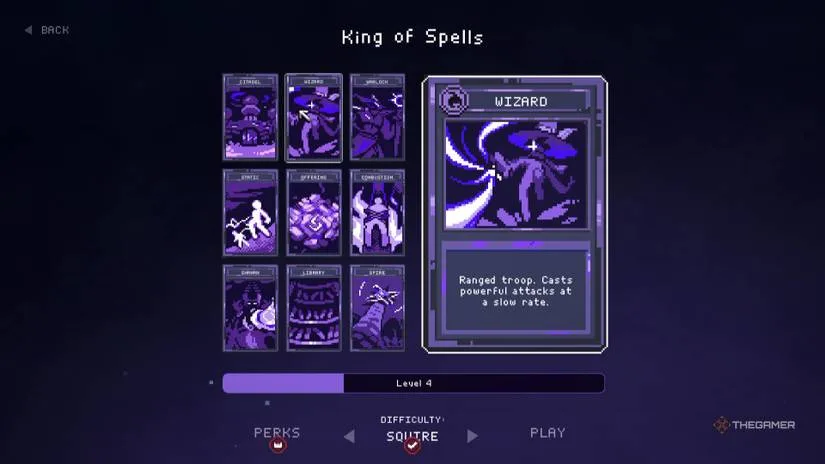
Historical card-description view for identifying Wizard; use the current Compendium for current statistics.
King of Nothing and Spells references
The Nothing deck supplies straightforward troop, tower, and support roles. The Spells deck emphasizes enchantments, support relationships, and units with different combat or indirect contributions. Cards from either deck can matter to another king when you obtain them through the run's available pool.
| Card | Deck | Selected role or interaction |
|---|---|---|
| Castle | Nothing | Base attack supplies area damage; inspect current speed and damage after the rebalances |
| Soldier | Nothing | Melee troop that can receive population, damage, and durability support |
| Paladin | Nothing | Defensive melee role that can hold enemies while other damage sources contribute |
| Archer | Nothing | Ranged troop with rapid attacks and projectile-related decree interactions |
| Scout Tower | Nothing | Tower whose projectile count increases with plot level |
| Farm | Nothing | Repeated population support for eligible adjacent troop plots |
| Blacksmith | Nothing | Damage support for eligible nearby troops and towers |
| Wildcard | Nothing | Upgrade tool for a placed plot, useful when a matching card is missing |
| Steel Coat | Nothing | Enchantment associated with negating incoming damage instances |
| Citadel | Spells | Base with lightning-related attacks and king-specific interactions |
| Wizard | Spells | Ranged damage troop; Arcane now rewards its enchantments |
| Warlock | Spells | Melee troop with area attacks; Sorcerous now links its HP to Tomes used |
| Shaman | Spells | Indirect troop support whose damage statistic contributes to its supporting role |
| Library | Spells | Develops enchantments on eligible adjacent troops |
| Spire | Spells | Healing support during battle, with a revised continuous attack rhythm |
| Static | Spells | Enchantment associated with chained damage on attacks |
| Combustion | Spells | Kill-triggered area-damage enchantment |
| Offering | Spells | Removes a target plot in exchange for random Tome cards |
These roles are a way to find the relevant card, not a ranking. A Library can be central to an enchanted troop while contributing little before the recipient has useful enchantments. A Farm can grow population but cannot replace the damage role missing from a kingdom.
Greed and Blood references
Greed includes cards that care about earning, holding, or spending gold. Blood includes cards that make ally deaths, destruction, summons, and pit actions part of the kingdom's development. Pay particular attention to current names and summon types in the Blood deck.
| Card | Deck | Selected role or interaction |
|---|---|---|
| Palace | Greed | Base associated with gold generation; do not use the obsolete infinite-damage description |
| Beacon | Greed | Adjacent speed support; current behavior also increases movement speed |
| Vault | Greed | Economy building that now levels automatically each year |
| Dispenser | Greed | Tower whose development is associated with gold earned |
| Mercenary | Greed | Troop count relates to gold held; revised ordinary cost is nine gold per unit |
| Thief | Greed | Mobile troop associated with reaching the enemy backline |
| Midas Touch | Greed | Enchantment that connects kills with a chance of gold generation |
| Mortgage | Greed | Destroys a target plot for a gold-related reward |
| Over-invest | Greed | Spends gold to improve the target; Golem interaction triggers twice as intended |
| Pagoda | Blood | Base summons Ghosts, with capacity developing through unit destruction |
| Imp | Blood | Troop useful as part of a death or population engine; leveling now emphasizes damage |
| Bomber | Blood | Troop that explodes on reaching a target; current pathfinding spreads its attacks |
| Demon Altar | Blood | Summon engine that develops through allied unit deaths |
| Cemetery | Blood | Skeleton engine with adjacent troop destruction and Pile of Bones interactions |
| Mangler | Blood | Death-related growth and meat-troll summons; now gains HP when destroying units |
| Oblation | Blood | Pit-related population card that replaces Vampirism |
| Sacrifice | Blood | Destruction action with benefits for adjacent plots |
| Carnage | Blood | Death-triggered area-damage enchantment |
Gold held and gold earned measure different things. Likewise, a plot destroyed during preparation and a unit killed in battle are different events. Check the exact trigger before assuming that every card in the same themed deck responds to the same action.
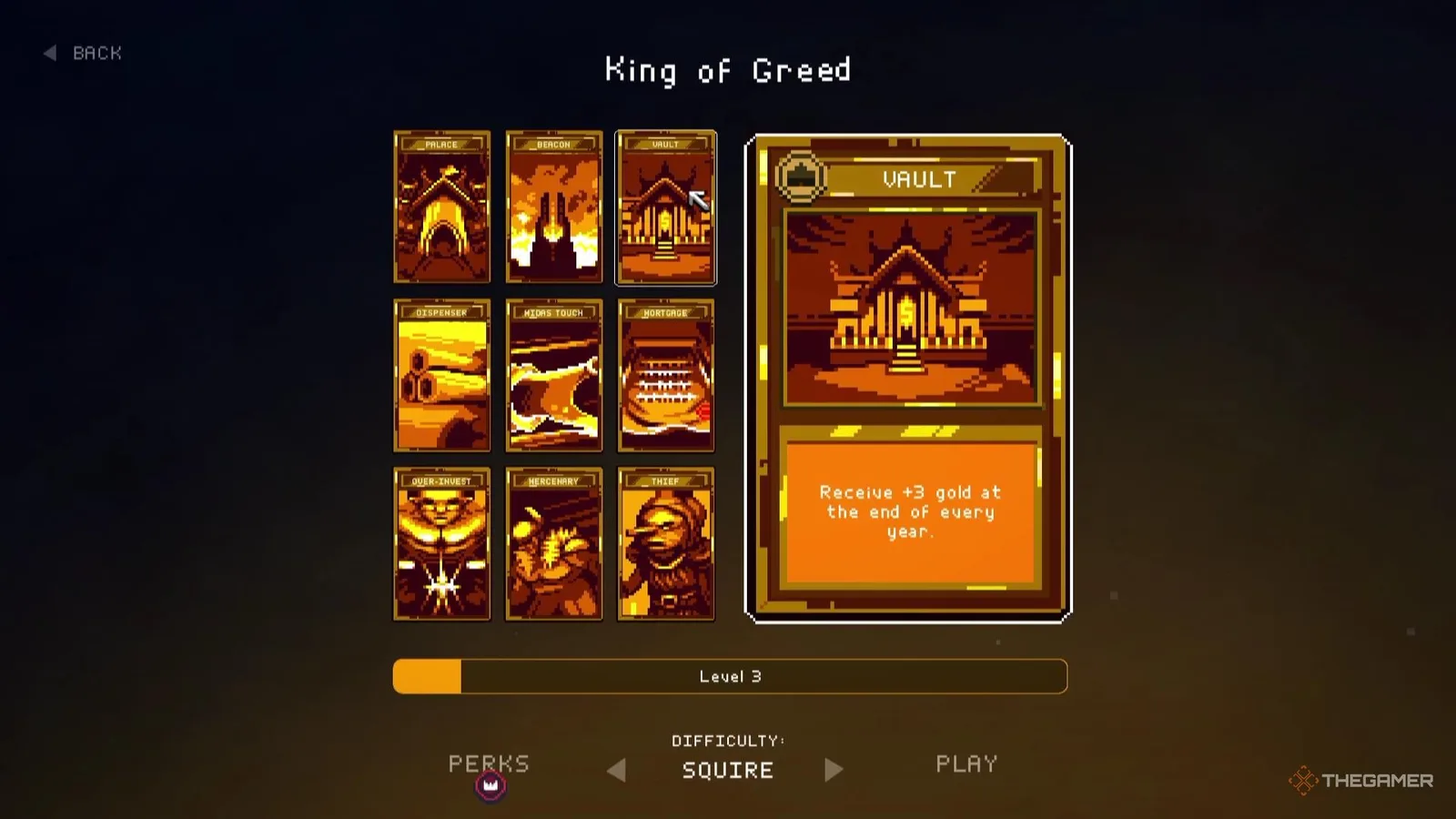
Historical interface illustration; use the current in-game description for effect values.
Nature, Stone, and Progress references
Nature supplies health, population, and growth relationships. Stone supplies fortifications, towers, and control. Progress rewards development and includes cards whose modern behavior differs sharply from early guides.
| Card | Deck | Selected role or interaction |
|---|---|---|
| Treant | Nature | Base contributes healing and damage through its attack behavior |
| Mycelium | Nature | Builds a spore army over time, making placement timing important |
| Elf | Nature | Ranged troop that targets a distant enemy |
| Boar | Nature | Adjacent rider relationship makes its health investment relevant to another troop |
| Forest | Nature | Continuing HP support for eligible nearby troops |
| Orchard | Nature | Control and damage card with a plot-level-related Gardener perk |
| Clone | Nature | Copies a selected card to help with placement or upgrades |
| Procreate | Nature | Adds population to a selected troop plot |
| Poison Vial | Nature | Current enchantment supplies three poison stacks rather than the old single stack |
| Stronghold | Stone | Base associated with battlefield tower creation |
| Quarry | Stone | Tower damage support that does not need adjacency to each tower |
| Trebuchet | Stone | Tower with area-damage projectiles and revised damage |
| Ballista | Stone | Slow, heavy attack; projectiles are now blocked by walls |
| Trapper | Stone | Traps stun enemies; duration increases with level and Hunter improves duration |
| Wallmaker | Stone | Fortification role with annual HP growth |
| Cauldron | Stone | Poison support supplying three stacks per level in the reworked baseline |
| Earthworks | Stone | Removes a target and supports expansion and card recovery |
| Mothership | Progress | Mobile base with movement-related development |
| Executioner | Progress | Ranged troop targeting a low-health enemy |
| Defender | Progress | Durable troop whose counterattacking role depends on being attacked |
| Lab Rat | Progress | Troop associated with adjacent leveling chains and unusually extensive development |
| Concabulator | Progress | Development building whose level milestone improves other plots |
| Converter | Progress | Changes enemy units through its attack effect; beam count increases with level |
| Recycler | Progress | Pit-triggered adjacent damage and HP support, replacing the old Precision deck slot |
| Overhaul | Progress | Destroys a plot and distributes upgrades elsewhere in the kingdom |
| Reinforce | Progress | Battle-time HP growth and healing beyond maximum HP, replacing upgrade-triggered damage |
Do not use an old tier label to fill a missing statistic. For example, dismissing Trapper based on early trap behavior ignores the later stun rework and damage changes. Read what the current card does and whether that role fits the board.
Selected Nomads, Time, and Rainbow entries
These selected entries cover important triggers and recent changes rather than the full contents of the three pools. Their value often depends on placement, movement, or an action you can repeat during preparation.
| Card | Group | Selected role or interaction |
|---|---|---|
| Warlord | Nomads | Base troop with a support role that differs from a stationary tower |
| Mob | Nomads | Population-related troop with a yearly growth perk |
| Camp | Nomads | Growth associated with changes to plots; it also triggers its own effect when placed |
| Dragon Den | Nomads | Destruction-related growth and large area attacks |
| Migration | Nomads | Movement card whose interactions require checking origin and destination relationships |
| Bastion | Time | Base that sends enemies back, providing more battlefield time |
| Portal | Time | Revisits earlier years while retaining kingdom progress |
| Warper | Time | Summons troops during battle |
| Hourglass | Time | Battle-duration-based tower with rebalanced late attack-speed progression |
| Amplifier | Time | Replicates received buffs to eligible adjacent plots |
| Orbiter | Time | Adjacency-based troop with corrected pre-applied enchantment handling |
| Adrenaline | Time | Battle-time speed development enchantment |
| Dwarf | Rainbow | Moves to an adjacent plot each year and gains stats when unlocking land |
| Codex | Rainbow | Returns copies of a Tome used on it before self-destruction |
| Warehouse | Rainbow | Adds applications of eligible neighboring support-building effects |
| Surge | Rainbow | Triggers a selected support building's effect nine times |
| Extraction | Rainbow | Destroys a target plot and returns five copies to the hand |
| Precision | Rainbow | Reworked first-hit damage enchantment, rather than the former Progress critical card |
Verify a combination from the reference
When you find a candidate card, inspect its live description and the plot that should receive its effect. Identify any requirement that the short table cannot carry, such as a target type, adjacency, a threshold, or whether the benefit happens only once.
Then inspect the active perks and decrees. Arcane changes the significance of Wizard enchantments, while Speculation changes Vault's development limit. Those are run or loadout relationships that a basic card listing cannot predict for every player.
For multiplayer, inspect the seasonal rainbow-card and decree pool before deciding that a special entry is obtainable. Patch #31 exposes the decree pool alongside the rainbow cards in the bottom-left lobby screen. Availability and mechanical usefulness are separate checks.
Finally, start a fresh run after updating. Updated descriptions and Compendium statistics are most useful when the run stores the current data. Use this reference to identify the role, and use the game to confirm the current value and the exact recipient before spending the card.
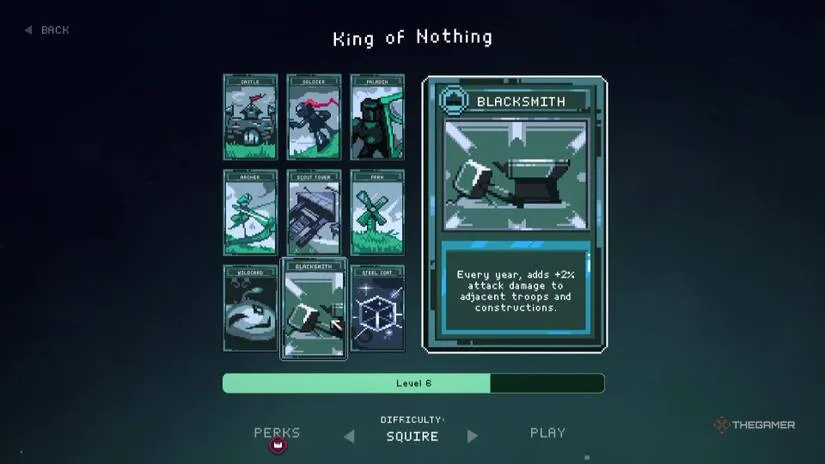
Historical interface illustration; use the current in-game description for effect values.